
Everything we know — galaxies, stars, planets, atoms, light, space, and even time — is part of one single thing: the universe.
According to the most widely accepted scientific theory, the universe began about 13.8 billion years ago with an event we call the Big Bang. It was not an ordinary explosion, but the emergence of space-time itself, which has since been expanding in all directions. This means that galaxies are not only moving away from each other: the very fabric of space is stretching, like a balloon slowly inflating.
The universe we are able to observe, the so-called observable universe, has an estimated diameter of about 93 billion light-years. Beyond that boundary, everything is speculation. Is the universe finite, ending in some form still beyond our comprehension, or infinite, extending endlessly? We do not yet have this answer. Our view of the cosmos is not limited by its actual dimensions, but by the speed of light and the time that has passed since the beginning of everything.
And in the midst of it all, here we are. Conscious beings inhabiting a small and wonderful blue dot, orbiting an ordinary star, lost among billions in one galaxy among countless others. And yet, we dare to seek answers. We dare to try to understand the whole.
“We are starstuff contemplating the stars,” said astronomer Carl Sagan. And it is no exaggeration: every atom in your body was once part of a star. Hydrogen, the simplest and most abundant element in the universe, serves as the fuel for stellar light. In the hearts of stars, under immense pressure, hydrogen atoms fuse to form more complex elements, such as carbon, the basis of life on Earth.
When these stars die, many of them explode as supernovae, scattering across the cosmos the elements they created. The same gravity that collapsed them begins once again to gather this cosmic dust into nebulas, which give birth to new stars, planets, and eventually, life.
Everything in the universe is in motion, though in daily life it goes unnoticed. The reason is simple: velocity is constant and there is no acceleration perceptible to our senses. Yet we are traveling through space at over a million kilometers per hour. Earth spins on its axis while orbiting the Sun, which in turn orbits the center of the Milky Way. The Milky Way itself is also moving, orbiting a common point with Andromeda, our neighboring galaxy. The two are even on a collision course — or rather, a merger — expected to occur in about 4 billion years.
And this is only the beginning. Our Local Group is made up of about 40 galaxies and is part of a larger cluster called the Virgo Cluster, which contains more than 1,300 galaxies. This cluster, in turn, belongs to an even larger structure known as Laniakea — a Hawaiian word meaning “immense sky.” Laniakea is estimated to contain over 100,000 galaxies and stretch more than 500 million light-years across.
And even this structure is not static: all of it moves, drawn toward something even greater, the Great Attractor, a mysterious region of intense gravity located within the Laniakea supercluster. It is a gravitational point where space itself seems to curve in such a way as to create an ordered flow of galaxies, all subtly pulled in its direction — like leaves drifting in an invisible current, or water spiraling down a drain.
On this grand scale, the universe reveals itself as an immense network of galaxy clusters interwoven with vast cosmic voids. Its structure resembles a fractal, repeating patterns across different scales. From a distance, it looks like a cosmic neural network, rivers of light flowing through space, or even the streets of a city glowing at night. Scientists call these formations cosmic webs. They represent the largest structures of the universe we can observe, since we are limited by our observable horizon — defined by the speed of light and the time that has passed since the Big Bang.
The human quest to unravel the universe seems endless. On the cosmic scale or the subatomic one, the more we advance, the more we realize there are hidden layers — deeper, more complex.
In the observable universe alone, it is estimated that there are more than 2 trillion galaxies. And within them, hundreds of sextillions of stars. And, astonishingly, all of this may have emerged from a single point, smaller than the tip of a needle — a point of infinite density we call a singularity. Mathematically, we can approach it indefinitely without ever touching it. A point where the known laws of physics simply collapse.
We know, then, that the universe as we know it had a “beginning.” But we do not know how it will end. Some scientists believe it will continue expanding indefinitely until energy and matter dissipate into absolute cold. Others consider the possibility of a cosmic collapse: gravity overpowering expansion, pulling everything back into a new singularity. This would be the so-called Big Crunch — or perhaps the beginning of another cycle, the Big Bounce.
Curiously, this idea is not new. In the ancient traditions of India, the universe is cyclical, with phases of creation and destruction, like the rhythm of Brahma’s breath: as he exhales, the universe is created; as he inhales, it returns to nothingness. A cosmos that pulses.
Perhaps the universe connects with other universes, just as air flows in and out of balloons. The cosmos expands and collapses upon itself, with black holes on one side and big bangs on the other, in a twin universe right beside ours.
There is much more to be said about the universe. Today we have the privilege of accessing almost all human knowledge in the palm of our hands. We can see images of distant galaxies, hear sounds captured by radio telescopes, and watch simulations of the universe’s birth. But the most important thing remains the same as ever: to think, to reflect, to imagine.
Think of The Infinite, the invisible, the immense. Think of everything that exists out there, in the cosmic webs and beyond them. We are small before the cosmos, yet immense in our desire to understand it.
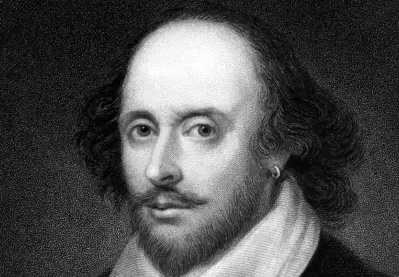
“There are more things in heaven and earth than are dreamt of in our vain philosophy”
William Shakespeare
The superstructures of the cosmos
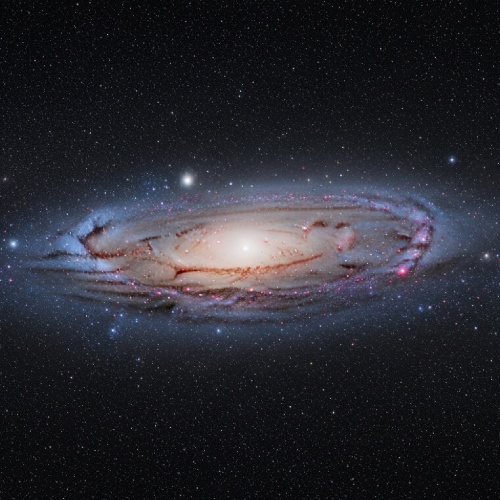
Galaxies
Our galaxy is a spiral disk about 100,000 light-years in diameter, home to more than 200 billion stars, planets, and interstellar dust, all orbiting a central supermassive black hole.
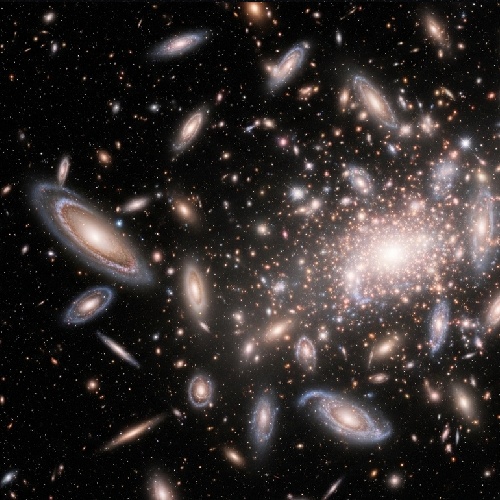
Clusters and Superclusters
We live in a small group of about 40 galaxies, including our own. Our Local Group is part of the Virgo Cluster, a collection of more than 1,300 galaxies bound together by gravity.
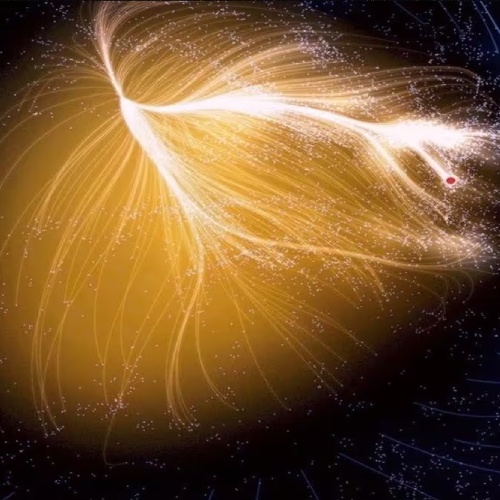
Hyperclusters
Laniakea is the hypercluster we call home. Its name means “immense sky,” and it encompasses more than 100,000 galaxies spread across 500 million light-years. The Milky Way is marked as the red dot.
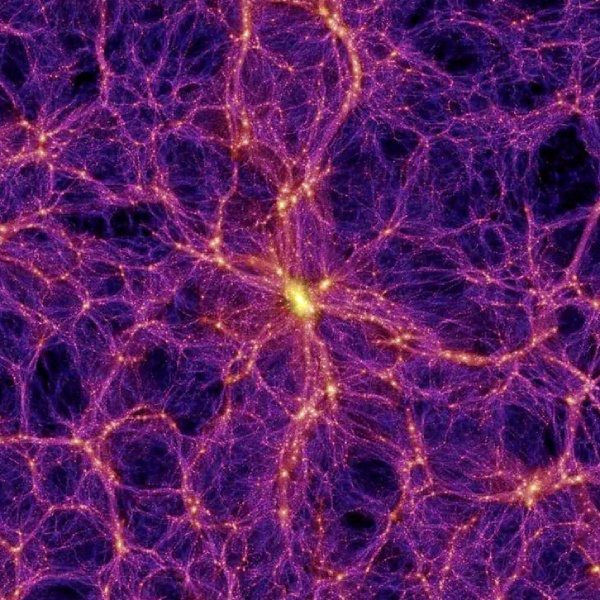
Cosmic web
On a large scale, the universe resembles a web: galaxies cluster together like nodes in a network, separated by vast voids. Its appearance is reminiscent of a giant brain or a city seen from above.
Observable universe logarithmic illustration
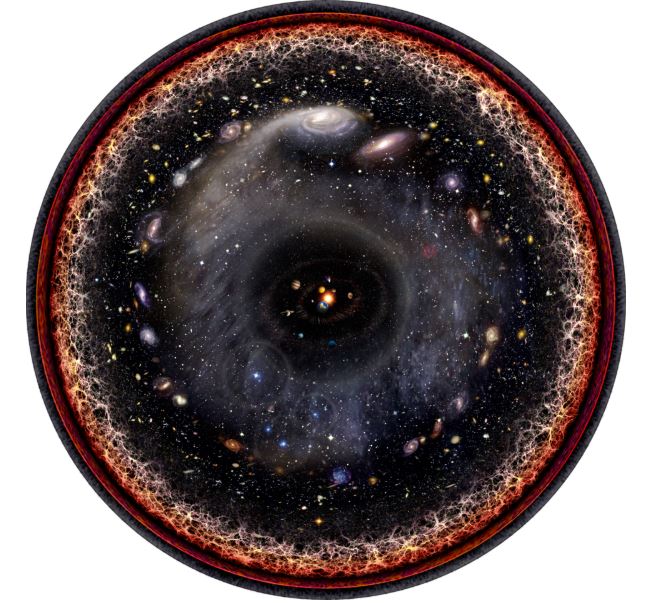
Image credit: Pablo Carlos Budassi. Illustrated logarithmic-scale conception of the observable universe with the Solar System at the center.
Surrounding the Solar System are the inner and outer planets, the Kuiper Belt, and the Oort Cloud. On a larger scale, the solar system is part of the Perseus Arm, which in turn is located within the Milky Way galaxy. In the galaxy, our closest neighbor is the Andromeda galaxy. On an even grander scale, the universe is organized into a vast cosmic web, permeated by cosmic microwave background radiation, and at the edges, the invisible plasma left over from the Big Bang. This image is based on logarithmic maps of the universe developed by researchers at Princeton University, along with images produced by NASA from observations made by its telescopes and traveling spacecraft.
The Big Bounce
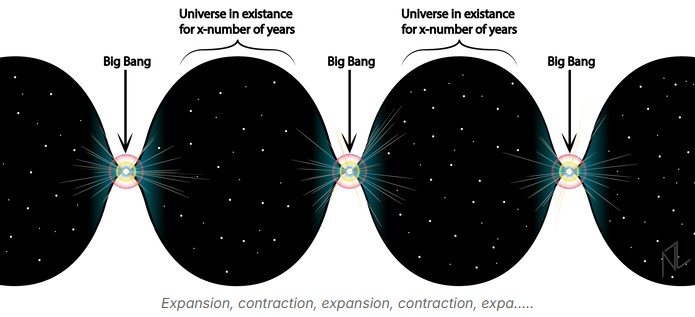
Multiverses
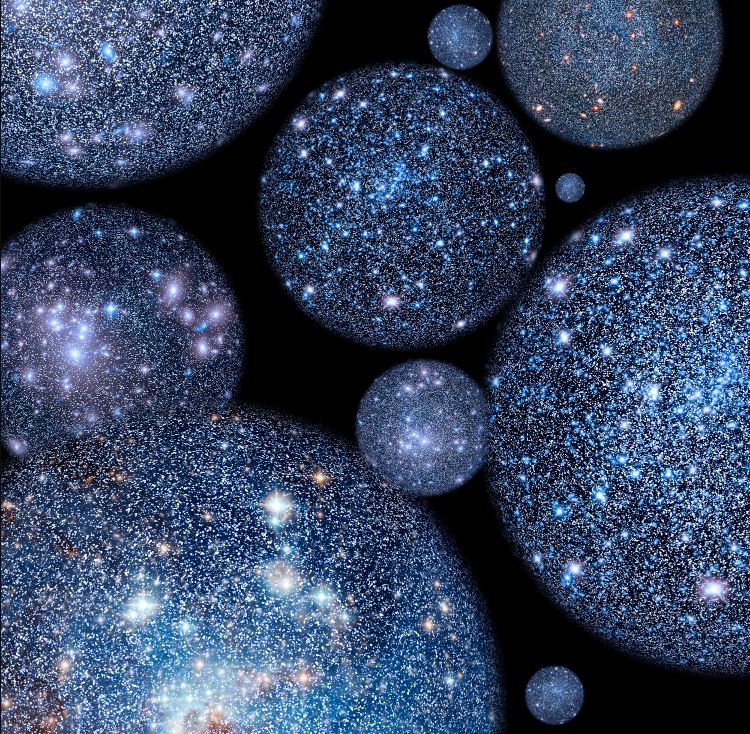
Despite the vastness of our universe, it may be only one among infinite others, each bounded by its own space-time and governed by distinct physical laws. Although this idea may sound like science fiction, serious research is underway. Scientists have been analyzing data collected by the Planck space telescope of the European Space Agency (ESA), whose goal is to detect irregularities in the cosmic microwave background — the first light to travel freely through the cosmos after the Big Bang. Among other objectives, researchers search for anomalies in the distribution of matter across the universe, which could represent possible evidence of collisions between our universe and others.

Enjoyed this? Keep reading the other articles. The topics are related, but they do not follow a specific order.
Share this article:

Enjoyed this? Keep reading the other articles. The topics are related, but they do not follow a specific order.
Share this article: