
Probably, if someone asks you what time is, you know. But if they ask you to explain what time is, things get complicated. Don’t worry — no one has managed to fully explain it yet. The idea of time is complex and very open to discussion. Even with all theories and studies, the nature of time remains an enigma — one of the great mysteries of the universe.
Time has been a central issue in philosophy since Antiquity, but its nature is controversial. Some think time is just a unit of measurement, like the movement of a clock hand marking the passing seconds. Others argue that time is a creation of the mind, made to help us understand changes in reality through the succession of events.
Aristotle, for example, considered time a measure of movement and change, not an independent entity. For him, time exists only because there is movement and change. It is a sequence of “before” and “after,” perceived by the soul that records the succession of events.
Saint Augustine thought that time did not exist outside the human mind, and that past, present, and future coexist within us through memory (past), attention (present), and expectation (future). For him, time was a mental construction, a reflection of our experience with the world — not an objective reality.
Time has always intrigued brilliant minds, who used their genius — and also their time — to try to define this concept and apply it in the most varied fields of human activity. Newton imagined time as something immutable, like a train running along infinite tracks at a constant speed. Then came Einstein, with his Theory of Relativity, and revolutionized this concept, proposing that time is flexible, affected by gravity and velocity.
According to this theory, gravity curves space-time. The greater the mass of an object, the greater the curvature and, consequently, the greater the effect on time. This means that time passes more slowly near massive objects compared to regions with weaker gravitational fields. Want to travel to the future? You can do that right now: just jump. Of course, even if you kept jumping your entire life, the time you would move forward would tend to zero. It would be far more efficient to hop on a spaceship and park it near a black hole.
Absolute in classical physics, relative in modern physics, mental creation or not — time has always been difficult to study and explain for scientists and philosophers. Yet for the most creative minds, time has always been a joy: inspiration for great works of art, famous quotes, novels, films, songs, and much more.
Time is also always present in our imagination. Who has never thought, at least once in life, about stopping time when running late for an appointment? Or how good it would be to fast-forward time in a boring line at the bank? If we think about it, perhaps we don’t even need the Theory of Relativity to realize that time is not absolute. Although the clock marks the same minutes, time definitely does not pass at the same speed when we are holding our breath underwater for three minutes versus enjoying three minutes on a roller coaster.
We can try to describe time, study it, and understand it, but one thing is certain: it passes — and we cannot stop it, nor modify it. The past cannot return, and the future does not yet exist. It is in the present that we can act and make decisions. Regret and guilt over past events, or anxiety about the future, don’t make much sense in practical terms. What matters is now. It is now that you can put to the test the lessons you learned from the past and plant the actions that will shape your future.
Perhaps time exists to force us to make decisions and experience the consequences of those choices. After all, that is how we evolve and learn.
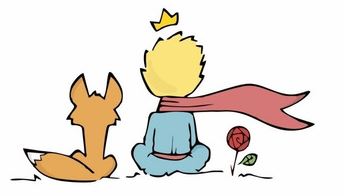
“It is the time you have wasted for your rose that makes your rose so important”
The Little Prince, by Antoine de Saint-Exupéry
The Twin Paradox
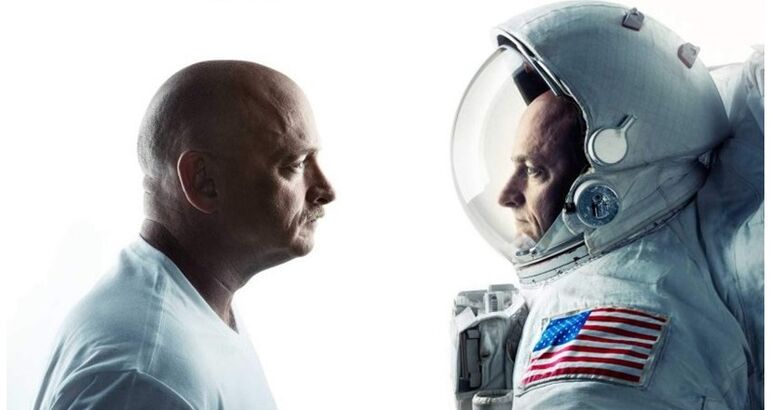
The twin paradox is a thought experiment in physics that explores the consequences of time dilation, a fundamental concept of Einstein’s Theory of Relativity. The paradox arises from comparing the aging of two twins: one remains on Earth, while the other travels through space at extremely high speed. According to time dilation, the traveling twin would age more slowly compared to the one who stayed on Earth.
The Fabric of Space-Time
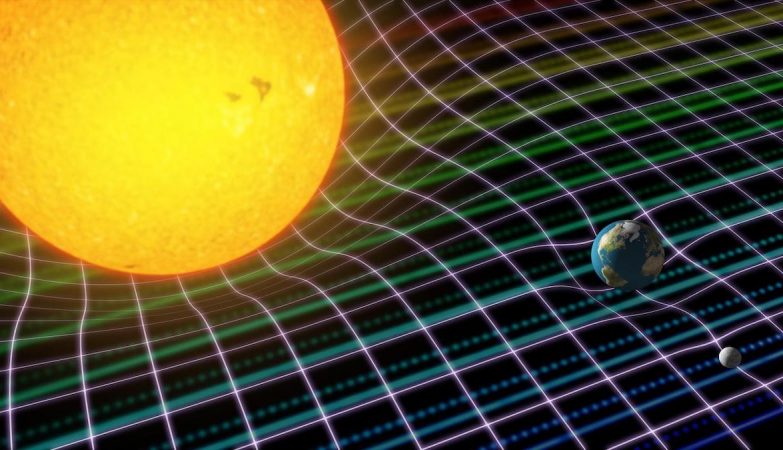
The fabric of space-time is a central concept in Albert Einstein’s General Theory of Relativity. Instead of treating space and time as separate entities, this theory unites them into a single structure: space-time — a kind of four-dimensional “mesh” or “fabric” (three of space and one of time), where massive bodies warp this structure around them. This model explains why bodies attract each other gravitationally and why light can bend when passing near a massive object, as happens with black holes.
Can We Travel to the Past?
In the 1978 movie Superman, the hero travels back in time to save Lois Lane, who dies in a landslide. He does this by flying around Earth at such an incredible speed that he reverses the planet’s rotation. This supposedly allows him to return to a point before the disaster and rescue Lois. The idea worked well in the film, but it has no basis in real physics. Time does not depend on the direction in which Earth spins, and changing its rotation would not make time flow backward. Traveling to the past is not possible in Einstein’s theories or according to current scientific knowledge.

Enjoyed this? Keep reading the other articles. The topics are related, but they do not follow a specific order.
Share this article:

Enjoyed this? Keep reading the other articles. The topics are related, but they do not follow a specific order.
Share this article: