
Have you ever, at some point in your life, reflected on The Infinite? Perhaps as a child, learning to count and wondering how far numbers could go; or gazing at the stars and the vastness of space, wondering where it all ends. Or maybe feeling love for someone dear and thinking how impossible it would be to measure it.
The Infinite: an easy and simple concept to grasp — something with no beginning or end, without borders or limits — and yet, at the same time, so difficult to truly comprehend. We realize that the human mind is not naturally equipped to absorb such immensity.
Since The Infinite has always existed, it didn’t take long for humanity to attempt to understand this mystery. Whenever people thought about time and space, The Infinite was there to complicate matters, and it quickly became clear that it would not be an easy task.
The Infinite has always been present in the philosophical, religious, and scientific questions of humankind. It is a concept used in various fields, especially in mathematics, philosophy, and theology. It lies at the core of the great existential questions.
In philosophy, religion, and science, The Infinite appears as a constant enigma. The ancient Greeks — perhaps the first to take this challenge seriously — sought to explain it through paradoxes. They used logical mental exercises to reveal the complexity of the idea, such as the famous paradox of Achilles and the tortoise, which suggests that even though Achilles runs faster, he would never overtake the tortoise if it had even a small head start.
For mathematicians, the concept of The Infinite could even feel hostile. There was no peace of mind after they discovered that the length of the diagonal of a square with sides of 1 is √2 (square root of two), written as 1.414213562…, a decimal sequence that goes on forever with no pattern and no end. A number that can never be written in full, only approximated.
By delving deeply into and attempting to explain, through numbers and equations, the paradoxes of The Infinite posed by the Greek philosophers, mathematicians developed tools like infinitesimal calculus — a revolution that shaped the modern world and became one of the foundations of today’s technologies. Thanks to it, we can now understand complex phenomena such as the motion of celestial bodies, the tides, the spread of diseases, the behavior of markets, the design of structures, and even the algorithms that sustain current technology.
However, it may be in theology that The Infinite feels most familiar to us. Almost all religions associate the idea of divinity with The Infinite — whether in the form of an eternal, absolute God or a creative energy that transcends time and space. Concepts like omniscience, omnipresence, and omnipotence are expressions of this divine infinitude. The Latin prefix “omni,” used in these attributes, means precisely “totality.” It’s as if we intuitively know that the sacred must be limitless.
Throughout history, these attributes have served as a reminder that any attempt to grasp the essence of God is, by definition, destined to be partial. The divine is, by nature, incomprehensible in its entirety — much like The Infinite.
The Infinite unsettles the human mind, like a boundary we can sense yet remains invisible and unreachable. It is a presence that escapes our understanding. Trying to comprehend it by multiplying the finite is a dead end for reason, which operates within limits, causes, and effects. How can one encompass something without edges, or a beginning, or an end?
We live within fragments: a small piece of time, a small piece of space. These are, in a way, the walls of our consciousness. We are born, live, and die within these slices of reality. We cannot truly imagine what something infinitely large or infinitely small is. Nor can we conceive of a time that never began or will never end. The Infinite subtly reveals the limits of our understanding.
There are people who believe the Earth is not round, people who believe in God or not, people who think we live in a “Matrix” or something else entirely — but no one doubts The Infinite. It is there, discreet and absolute. As if somewhere deep within us, we knew there is something greater, something beyond the control of the mind and words. Something that points to the mystery of the universe and, perhaps, the mystery of ourselves.
The Infinite should not be experienced or felt as something confined. It is about possibilities. It does not end in black or white, in shadow or light, in right or left. The Infinite embraces every shade in between — and beyond — concepts and polarities.
There is no place where The Infinite feels more at home than in your thoughts. It is in the imagination, in the mind, that everything is possible. And I’m not talking about fantasies, but about the real potential that exists in the act of thinking, of learning, of reasoning. It is there that you can explore all kinds of ideas, without judgment, without dogmas, without taboos.
The Infinite shows us that there is always more to discover. It reminds us to remain humble in the face of the unknown. No matter how absurd an idea may seem, you can simply ask yourself: “And why not?” Or: “If it’s not this way, then how is it? I’ll create my own version.” Then, you filter what makes sense to you. But the universe of ideas is infinite.
Our understanding of our own reality is very limited — and there is no better example of that than The Infinite.
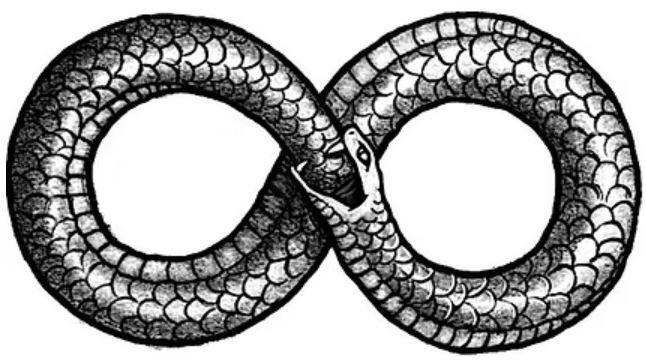
The Ouroboros is an ancient symbol, depicted as a serpent devouring its own tail, forming a circle. It symbolizes the idea of eternity, renewal, and continuity, where the end and the beginning are merely parts of the same flow. Associated with the cyclical nature of time and life, the Ouroboros reminds us that everything is in constant transformation: the present dissolves in the very next instant, consumed by the future, while the new is born from what has ended. It is the symbol of the infinite manifested in time.
Calculus: mathematics of the infinite
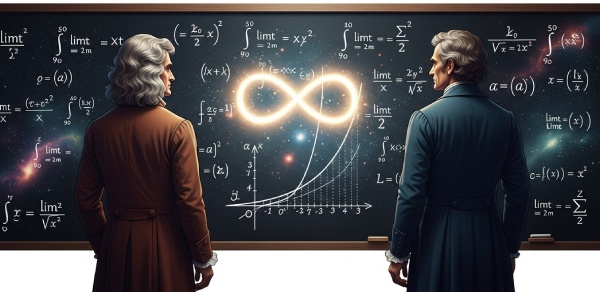
Developed in the 17th century, independently by Isaac Newton and Gottfried Wilhelm Leibniz, calculus was born from the need to understand motion and continuous change. It deals with quantities that are infinitely small — the so-called infinitesimals — and allows us to explore what lies between two points, between two moments. In attempting to describe infinity with precision, humanity created one of the most revolutionary tools in science. To this day, calculus remains the mathematical bridge that connects the finite to the infinite.
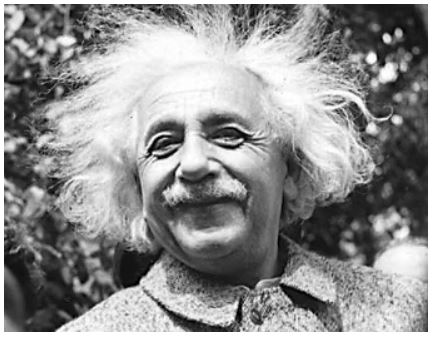
“Imagination is more important than knowledge”
Albert Einstein
Achilles and the Tortoise
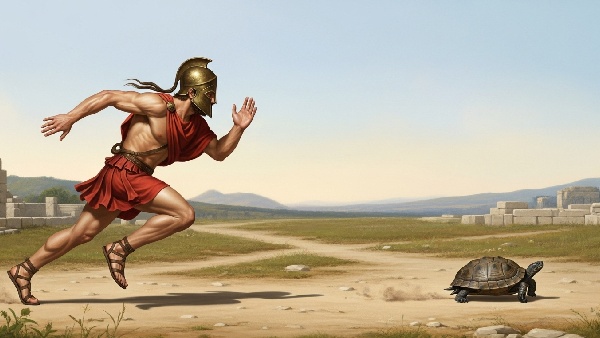
The paradox of Achilles and the tortoise, proposed by Zeno of Elea, seeks to reveal the contradictions in the idea of motion when dealing with infinity. In it, Achilles, the swift hero, gives the tortoise a small head start in a race. Zeno argues that, for Achilles to catch up, he must first reach the point where the tortoise began; but by then, the tortoise will have moved a little farther ahead. And so on: each time Achilles reaches the tortoise’s previous position, she will have advanced slightly more. Although Achilles is faster, the reasoning seems to suggest that he would never catch her, because there will always be a remaining distance to cover, with space and time divided infinitely. This paradox reveals how infinity, when taken to the extreme, challenges our intuition and logic.
The Library of Babel
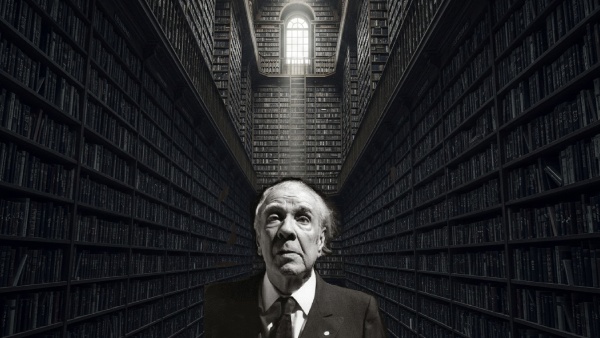
The Argentine writer Jorge Luis Borges, in his celebrated short story The Library of Babel, conceived a powerful metaphor for infinity: a library containing every possible book, each with a unique combination of letters, punctuation, and spaces — including every variation of everything that has been or ever could be written. This library is a labyrinth of possibilities, where meaning hides between chance and repetition. Borges invites us to see infinity not as the absence of spatial limits, but as an overwhelming excess of alternatives, turning it into a metaphor for the human condition: trapped between everything and nothing, between what we can understand and what will always elude reason.
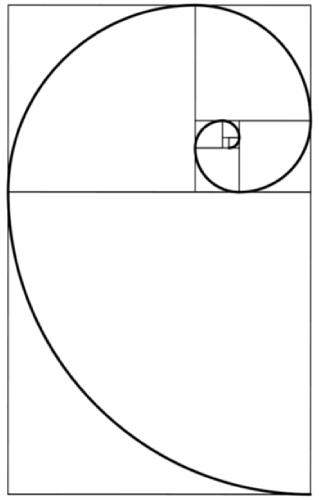
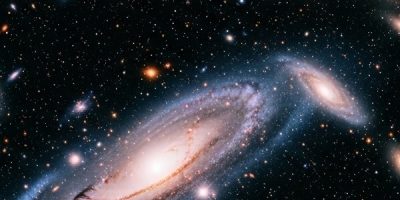
The Fibonacci sequence is a numerical series in which each number is the sum of the two preceding ones, forming a progression that grows indefinitely — 0, 1, 1, 2, 3, 5, 8, 13… and so on, toward infinity. It appears in surprising natural patterns, such as the spirals of seashells, the arrangement of flower petals, galaxies, and even the growth of populations. This regularity reveals that infinity does not have to be abstract or distant — it manifests in a concrete, repetitive, and harmonious way within the very structure of nature.
Enjoyed this? Keep reading the other articles. The topics are related, but they do not follow a specific order.
Share this article:
Enjoyed this? Keep reading the other articles. The topics are related, but they do not follow a specific order.
Share this article: