
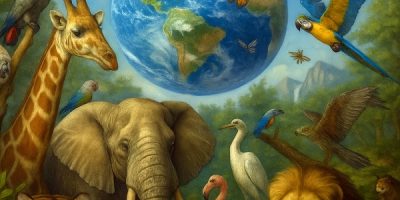
When we think of Nature, what usually comes to mind are lush landscapes and animals in the wild. Of course, these elements are part of it, but the concept of Nature goes far beyond that. In its broadest sense, Nature is the sum of everything that exists in the universe and that was not artificially created by human beings.
It encompasses everything from physical environments—mountains, rivers, oceans, forests, animals, climate, planets, and stars—to life in all its forms, from microorganisms to human beings. It also includes the invisible and complex processes that govern the functioning of the world: gravity, photosynthesis, the cycles of water, life, and matter.
In the beginning, natural phenomena—such as storms, eclipses, volcanoes, and earthquakes—were seen as manifestations of gods or supernatural forces. The unknown inspired fear, and Nature was perceived as something mysterious, powerful, and unpredictable.
Over time, however, humans began to observe patterns, seek rational explanations, and turn fear into curiosity. By observing the stars, for instance, astronomy was developed, allowing people to predict seasons, establish calendars, and organize harvests more effectively. Knowledge of the winds, stars, and tides led to the advancement of navigation, enabling exploration and connections between distant cultures.
With the advance of technology, humanity radically expanded its ability to explore the deepest and most invisible aspects of Nature. Tools such as microscopes, telescopes, measuring instruments, and computational systems allowed us to go beyond the reach of the senses, revealing worlds that were once hidden.
We discovered the existence of microscopic organisms, essential for health, decomposition, and the cycles of life. We came to understand phenomena such as electromagnetism, present from visible light to radio waves and digital technologies. We entered the realm of nuclear forces, learning how atoms function and exploring both energy and the risks of radioactive reactions.
We deepened our knowledge of the human body, from the functioning of organs to the genetic code that shapes us—DNA, which today can be sequenced, edited, and even manipulated in some medical and biotechnological applications. In addition, the study of the human brain opened new frontiers, allowing us to investigate consciousness, thoughts, emotions, and the biological foundations of the mind.
This progress shows that humanity was not content with merely living in the natural world: we want to understand it deeply, intervene in it, and even transform it. Nature, once only observed, is now also investigated, manipulated, and rediscovered on increasingly complex levels.
Although we have unveiled part of its mechanisms, we are only beginning to understand its mysteries. We grasp concepts such as attraction, repulsion, instinct, reason, and intelligence. Yet Nature transcends these concepts. It surprises us with the sophistication of its processes, the interdependence of all elements, and the dance between order and chaos, forming incredibly balanced systems. Within it dwells an intrinsic wisdom—silent and eternal.
We know that the Big Bang gave rise to the universe, that gravity gathered matter, forming stars and planets. But what caused atoms to organize into complex molecules capable of replicating, generating life, intelligence, and consciousness? The precision and balance of it all defy the idea of mere chance.
When we observe how a seed knows how to become a tree, how the body heals itself, how an ecosystem maintains its balance, or how galaxies form according to precise patterns, we are led to reflect on a universal wisdom.
Nature is the living manifestation of an intelligent, creative, and omnipresent principle—something that transcends time, space, and matter, yet is present in everything, from the infinitely large to the infinitely small. Its laws operate both in the cosmos and in the quantum world.
It is as if the blueprints of this cosmic engineering were imprinted everywhere, with perfect and accessible instructions. These secrets seem to reveal themselves as we evolve, becoming more aware and attuned to this greater wisdom.
Nature, of which we are part, invites us to participate in this ongoing creation. But before we can become co-creators, we must learn from it—mirroring its balance and its wisdom.
Nature is the purest and most transparent manifestation of the intelligence of the universal creative source.
Wood Wide Web
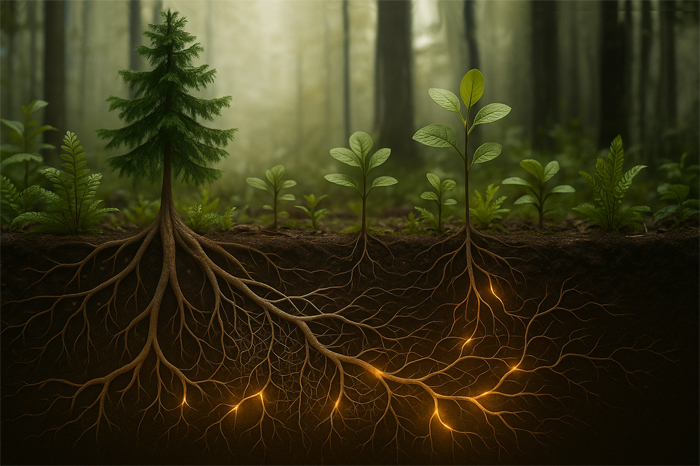
Although they lack a brain or nervous system, plants display surprising behaviors that challenge the traditional view of intelligence. They form complex underground networks with fungi (known as the Wood Wide Web) and communicate through chemical signals, warning others about threats such as predators or pests. They are also capable of learning, adapting their growth to the environment, and even cooperating with one another.
Eclipse
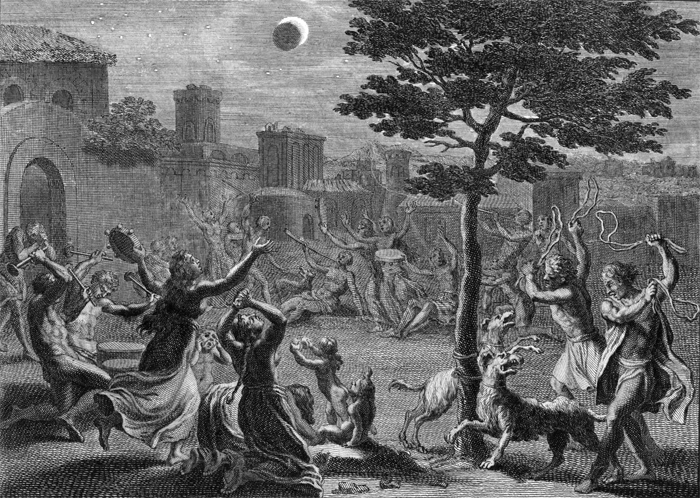
Bernard Picart. Desolation of the Peruvians During the Lunar Eclipse – 18th-Century Engraving
Without scientific understanding, humans once feared eclipses, seeing in these celestial events something mysterious and unsettling: the Sun or the Moon—bodies essential to life and to the natural order—suddenly vanishing from the sky. This fear was fueled by the unpredictability and dramatic appearance of the phenomenon, which broke the routine of the heavens and stirred a deep sense of vulnerability before the forces of nature.
Microcosm and Macrocosm
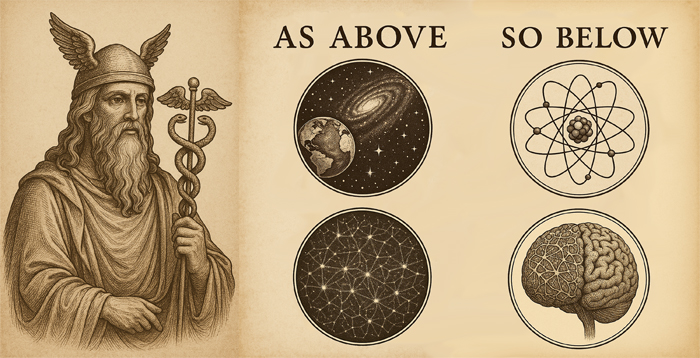
The phrase “as above, so below” comes from the Principle of Correspondence, one of the Seven Hermetic Laws of the Kybalion. This ancient text of esoteric philosophy, attributed to Hermes Trismegistus, seeks to reveal the connection between all levels of existence. The central idea is that the structures, patterns, and laws that govern the macrocosm are also reflected in the microcosm, creating a mirroring between the vast and the minute. For example, there is the similarity between the orbital system of atoms and that of solar systems. Another striking example is the human brain. With its billions of interconnected neurons, it presents a structure visually similar to the cosmic web of galaxies, which points to an intelligent design hidden throughout creation.
Living Library
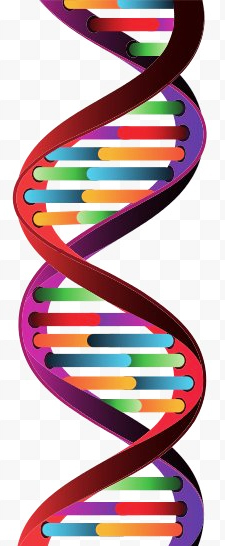
DNA can be considered a true living library because, within its molecular structure, it stores all the information needed to build, maintain, and reproduce a living being. Just as a library preserves books carrying the knowledge of generations, DNA holds encoded instructions that are passed from parents to offspring, preserving the evolutionary history of a species. Each gene is like a “book” or “chapter” that describes specific functions, and reading this material is what allows cells to know what to do at every moment of life.

Enjoyed this? Keep reading the other articles. The topics are related, but they do not follow a specific order.
Share this article:
Enjoyed this? Keep reading the other articles. The topics are related, but they do not follow a specific order.
Share this article: