
In simple and general terms, it’s easy to say whether something is alive or not—you are alive, of course, and a rock is not. But when we look closer, this distinction becomes far more complex. There are many definitions of “life,” and none of them is definitive or universally accepted. For centuries, scientists have tried to understand exactly what life is and to draw a clear line between what is alive and what is not.
Until the 19th century, it was believed that living beings possessed something special, like a “vital spark,” a mysterious and invisible force responsible for animating matter and setting it apart from what is inert. This idea, called vitalism, dominated natural philosophy for centuries and was deeply rooted in the scientific thought of the time.
With the advance of science and the invention of instruments like the microscope, discoveries such as the existence of cells, the functioning of tissues, and later, the structure and role of DNA (deoxyribonucleic acid) showed that phenomena once attributed to something immaterial could be explained by extremely complex chemical and physical interactions. This revealed many truths, but it also made it even harder to precisely define what it means to be alive.
If we set aside spiritual and philosophical questions—which complicate the subject even further—and focus on a scientific perspective, most definitions of life include some common characteristics: having cellular organization, being able to reproduce, carrying out metabolism (transforming energy), responding to environmental stimuli, and adapting over time (evolving).
Before exploring some concepts and why it is so difficult to define life, let’s begin with a fundamental question: when and how did life arise?
The main scientific theories suggest that life began on Earth about 3.8 billion years ago (the planet itself is around 4.5 billion years old). It is believed that life emerged in a kind of “organic soup,” formed by substances like methane, hydrogen, and ammonia, mixed with the waters of the primitive oceans and exposed to an atmosphere very different from today’s. Over millions of years, this mixture was constantly stirred by electrical discharges (lightning), volcanic heat, and solar radiation.
These forces helped transform simple compounds into more complex organic molecules. Over time, some of these molecules began to group together and form structures enclosed by membranes, which gave rise to the first “organized clusters”—a possible step toward the earliest forms of life.
To this day, no one knows for certain how or when this happened. Although scientists have managed to simulate this “primordial soup” in laboratories and create organic molecules from simple elements, no one has yet been able to generate a living organism from it. In other words, we still don’t know how to turn chemistry into life.
Why is it so hard to define what life is? Let’s look at some examples that show how blurred the line between “alive” and “not alive” can be:
Viruses
Viruses are perhaps the greatest challenge to defining life. They contain genetic material, can evolve and adapt, and cause disease—all of which seem quite “alive.” Yet they cannot reproduce on their own; they only do so by invading the cells of living organisms. Outside of a host, they are little more than inert packages of molecules. For this reason, some scientists consider them alive only when inside a cell, while others classify them as biological entities, but not alive.
Polymers
Polymers are long chains of molecules made of smaller units. Biological polymers (like DNA and proteins) are present in all living beings and form the foundation of life. But on their own, they are not alive—they are simply chemical substances. Still, without them, life as we know it would not exist. They show how life can be built from parts that, individually, are not alive.
Crystals and chemical reactions
Crystals, like salt or ice, can grow, “reproduce” by dividing, and even organize themselves in complex ways. But they have no metabolism and do not evolve. Some chemical reactions in laboratories can also self-organize, replicate patterns, and even “respond” to stimuli. Yet, no one considers these reactions to be alive.
Artificial Intelligence and robots
With advancing technology, increasingly autonomous and complex machines have emerged. Some can learn, make decisions, and “interact” with the environment. Still, they have no metabolism, no cells, no DNA. Are they alive? Not as we define life today—but these examples raise new questions about what might, in the future, be considered a form of life.
When we talk about “life,” we must also remember that we have only been able to study life on Earth—life that is carbon-based and uses water as its universal solvent, since both work very well under our planet’s conditions. But on other planets, under extreme temperatures, life would need to adapt in entirely different ways.
A likely candidate to replace carbon would be Silicon (Si), which sits just below carbon on the periodic table and, like carbon, can form four chemical bonds—essential for building complex molecules. Silicon is also more stable at higher temperatures and could serve as a chemical basis for life in environments hotter than Earth.
Another example, this time for replacing water as a universal solvent in very cold places, is Ammonia (NH₃). It can dissolve many organic substances and remains liquid at much lower temperatures (its freezing point is –77ºC).
The universe is immense, and even within our own galaxy there are hundreds of billions of stars with trillions of planets. It is perfectly possible that organisms exist that evolved with a different “chemistry of life,” unknown to us—so different, in fact, that we might not even recognize them as “life” at first glance.
We know that diversity and time are not obstacles for the universe. The “organic soup” that arose on Earth could just as well have emerged elsewhere, with different elements and under different pressures and temperatures. If there is one thing life on Earth has taught us, it is that it is incredibly adaptable. There are microorganisms that survive in volcanoes, glaciers, deserts, and even nuclear reactors. This opens the possibility that, on other worlds, life may have found creative ways to arise and persist—even under conditions that would seem impossible to us.
Perhaps on distant planets, life does not need water or warmth, nor does it breathe oxygen. It may be built on a completely alien chemistry, in strange bodies we cannot even imagine. Perhaps it is slow and resilient, surviving in frozen methane deserts; or it may have incredibly fast metabolisms in oceans of liquid metals—or even exist in the form of plasma or energy.
Defining life is not simple. It seems more like a spectrum than a fixed category: some things are clearly alive, others clearly not, and many fall somewhere in between—or perhaps in forms we cannot yet imagine or conceive. As science advances, the mystery only deepens.
The diversity of life may be greater than any dream or hypothesis of science.
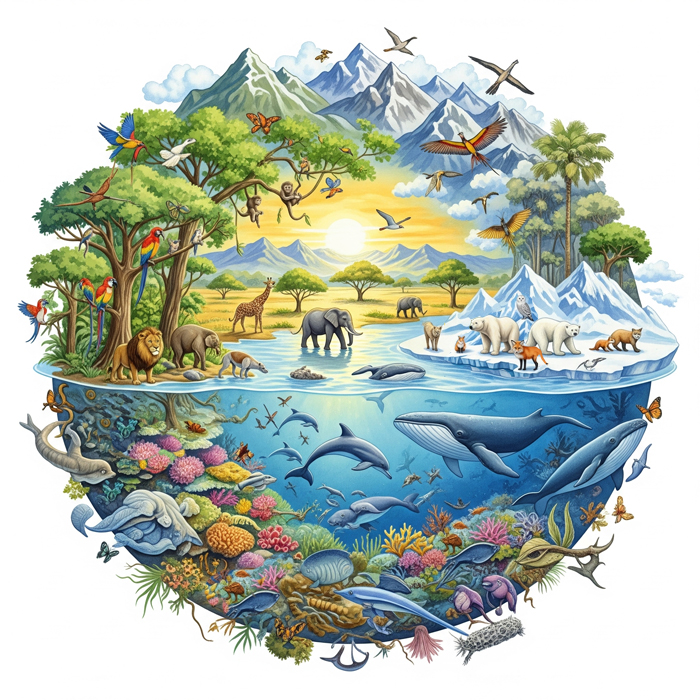
Earth is home to an astonishing biodiversity, the result of billions of years of evolution. Millions of species live in forests, oceans, deserts, and polar regions, each adapted to its own environment. In the oceans, fish and whales follow long migratory routes; in the deserts, plants and animals endure water scarcity; on the ice, penguins and seals withstand the extreme cold. From invisible microorganisms to monumental creatures, life on Earth reveals an extraordinary capacity for adaptation and resilience.
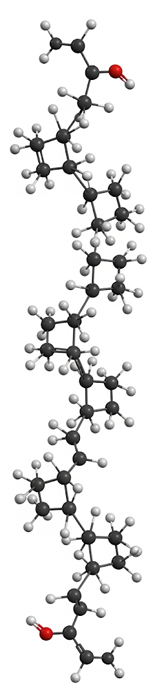
Carbon (C) – The Basis of Life
Life as we know it is based on carbon because of its extraordinary chemical versatility. This element can form four stable covalent bonds, allowing it to create an immense variety of structures—from long linear chains to complex three-dimensional molecules such as proteins, lipids, sugars, and DNA itself, which carries the code of life. Carbon also interacts very well with water, life’s essential solvent, facilitating biochemical reactions in aqueous environments. This atomic flexibility makes carbon the backbone of all living beings, enabling the complexity and diversity necessary for life to exist on Earth.
Titan – Moon of Saturn
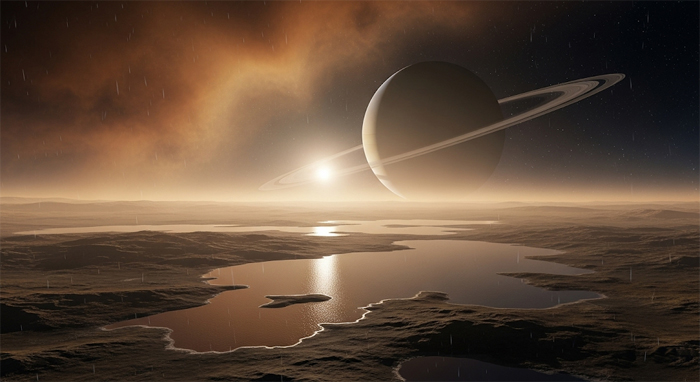
Titan, Saturn’s largest moon, is one of the most intriguing places in the Solar System when it comes to the search for life. With lakes and rivers of liquid methane, a dense atmosphere rich in organic compounds, and an active hydrological cycle—similar to Earth’s, but based on methane—Titan offers unique conditions that capture the interest of astrobiology. The possibility of life forms that “drink” methane and use different compounds to generate energy challenges our very understanding of what is necessary for life. Missions such as Cassini-Huygens have already revealed much about this frozen world, and future explorations—like NASA’s Dragonfly mission—may bring even more surprising answers.
Silicon-Based Alien
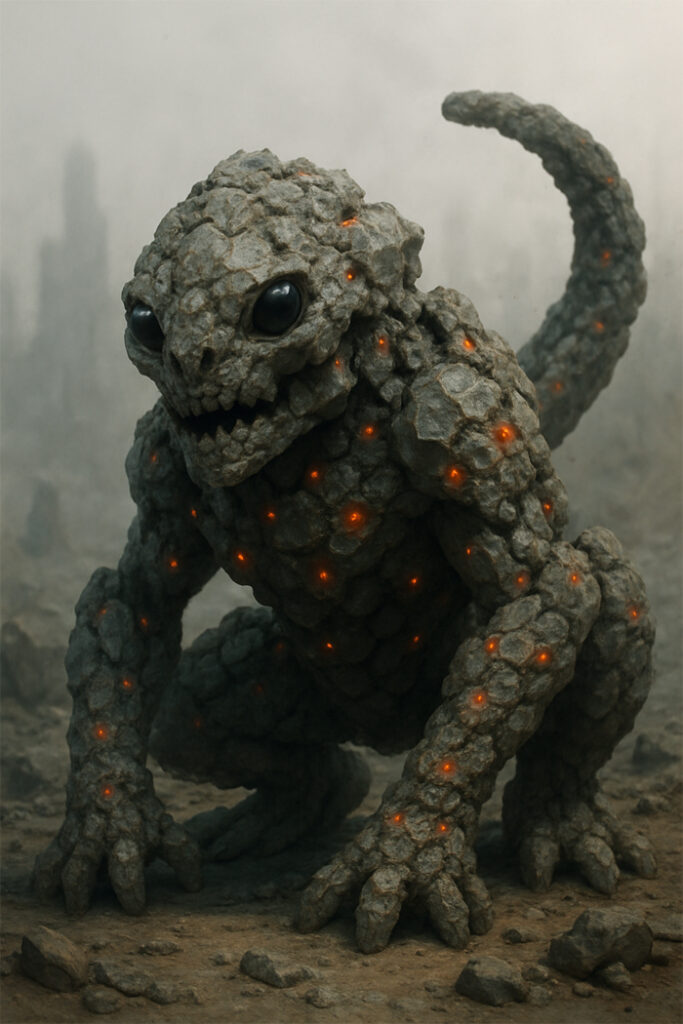
This fictional creature, generated by AI, inhabits a volcanic planet with temperatures so high that carbon-based life, like that of Earth, could not survive. Its body is formed by a mineral exoskeleton that grows and regenerates over time, much like crystals forming in deep caves.
Despite its robust, rock-like appearance, its arms and legs are surprisingly flexible, with joints adapted to move across hostile terrain under high gravity and uneven volcanic surfaces. Bright orange spots scattered across its body serve as bioluminescent organs, essential for visual communication in dark environments such as deep caves. They express themselves through pulsating light patterns—a living language of luminous signals.
Since there is no liquid water in its world, its biology uses sulfuric acid (H₂SO₄) as a solvent. This compound is stable at high temperatures and, like water, is highly polar, enabling vital chemical reactions. Its energy does not come from food or oxygen, but from chemical reactions between minerals and heat—a thermochemical metabolism that turns the hostile environment into a source of life.
Its nervous system is not concentrated in a single brain but distributed in crystalline silicon nodes throughout its body, forming a decentralized intelligence. Instead of veins and blood, it has channels where superheated mineral fluids circulate, carrying energy and nutrients. Its “muscles” are flexible mineral fibers that contract or expand when heated or chemically activated, allowing movement even with a mineralized body.
This species has no genders. Reproduction occurs through the exchange of silicon fragments containing a kind of “crystalline memory”—as if it were a biological flash drive carrying genetic data. The new being develops inside a special cavity in the body of one of the progenitors until it reaches autonomy and survive on its own.

“To live is the rarest thing in the world. Most people exist, that is all”
Oscar Wilde

Enjoyed this? Keep reading the other articles. The topics are related, but they do not follow a specific order.
Share this article:

Enjoyed this? Keep reading the other articles. The topics are related, but they do not follow a specific order.
Share this article: