
The universe is in constant evolution. Stars are born and die, galaxies drift apart, atoms vibrate, thoughts arise and fade. Behind all of this lies a fundamental and hidden force that drives everything: energy.
Energy is movement, heat, light, life. It is the ability to generate change, to put something into action. It cannot be created or destroyed, only transformed. This is one of the most fundamental laws of nature: the energy of the universe is constant. What changes is the way it manifests itself — in the power of a stellar explosion or in the subtlety of electrical impulses traveling through biological networks. Hello, brain!
A seed sprouts because there is potency stored within its cells. A lightning bolt cuts the sky because energy has built up among the clouds. The Sun warms the Earth because it performs nuclear fusion in its core, releasing immense amounts of energy every second. Even we humans only exist as we are because our bodies constantly process the energy from food, transforming it into heat, movement, thoughts, feelings.
A guitar string vibrates faster when more energy is applied. It can vibrate so quickly that we cannot see the movement or hear the sound — slipping past our perception. But that doesn’t mean the string isn’t there, does it?
Many spiritual traditions believe in the existence of an energy we cannot see, though some feel it and others intuit it. The Chinese chi, the Indian prana, the “spirit” of spiritualists — all point to a vital energy that permeates and interconnects everything.
If matter is energy that organized itself, then life is energy that became conscious of itself. The flow of life in an organism, the exchange of nutrients, breathing, the beating of the heart — all of it is energy in action. And when we talk about emotions, thoughts, or states of consciousness, perhaps we are only accessing more subtle levels of this same force.
On the cosmic scale, energy is anything but shy. Stars are born and die, releasing colossal amounts of energy. Galaxies attract, collide, and merge, following invisible laws that shape the architecture of the universe. Gravity, one of the most mysterious manifestations of this force, binds everything together in a cosmic web that defies human comprehension.
There are forms of energy that remain invisible to science. Dark matter, for instance, seems to exert gravitational influence but does not interact with light. Its existence is inferred only by indirect effects. There is also dark energy, a placeholder name for something even more enigmatic: the force accelerating the expansion of the universe. It is as if the cosmos holds a latent, silent energy that fuels its own creation.
Every atom, every particle, carries within it an immense amount of potency, as if the universe had hidden dynamite inside grains of sand. What appears static may be pure potential. The most widely accepted theory for the origin of the universe is the Big Bang: the release of all the energy that exists in the cosmos today, from a singularity, an infinitely small point. Energy came before matter, even before time. It came from infinite densities and temperatures. There was no “before” the Big Bang, since time itself — along with space — emerged from that event.
In the beginning, there was only a soup of energy, composed of elementary particles and antiparticles in a state of balance. As it expanded and cooled, this energy became the original building block for all the matter that now forms the universe.
This force pulses through everything. In the warmth of a hug, the spark of an idea, the light of a thought. Human consciousness itself may be one of the most subtle expressions of this universal energy.
Everything that changes, everything that lives, is energy manifesting. We can think of Energy as another word for possibilities. Infinite possibilities.
Kirlian Effect or Aura?
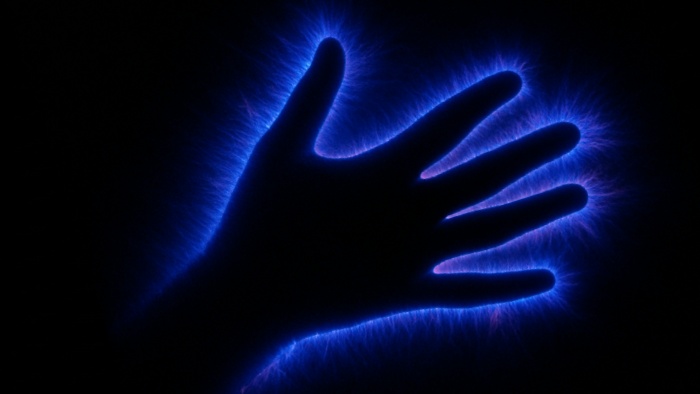
Kirlian photography, or the Kirlian effect, is a technique that captures images of electrical discharges around objects, especially living beings such as hands or leaves. This is done by applying high voltage to a photographic plate in contact with the object, which ionizes the surrounding air and produces a visible glow. Despite its well-understood physical basis, Kirlian photography gained popularity in esoteric contexts, where it is seen as a way to visualize energy fields or emotional states. While science sees only electricity and ionized air, others perceive in it a reflection of the invisible — a photograph of the aura.
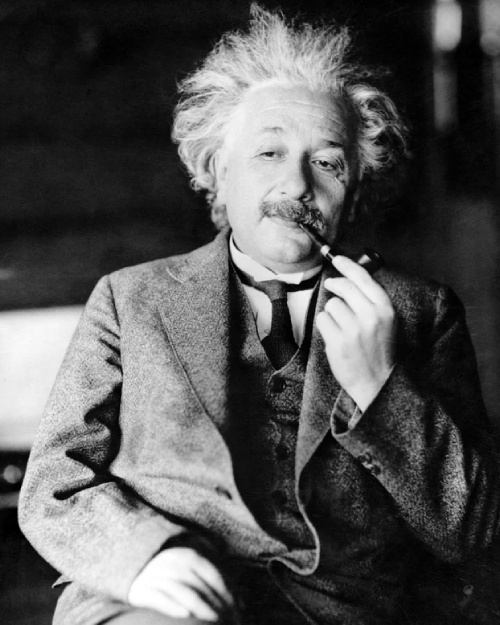
Albert Einstein revolutionized physics by formulating the equation E = mc², which shows that mass and energy are equivalent. This means that a small amount of matter can contain an enormous amount of energy, since it is multiplied by the square of the speed of light. The formula revealed that matter is, in fact, condensed energy, and that under certain conditions, one can transform into the other.
Our Primary Source of Energy
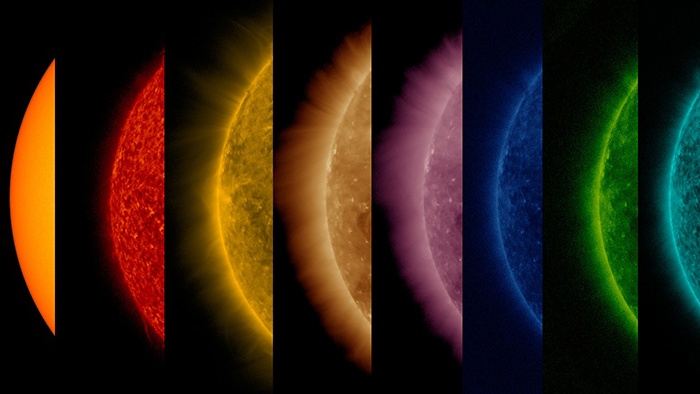
In this stunning sequence captured by NASA’s Solar Dynamics Observatory (SDO), the Sun is revealed in different layers — from its surface to the upper atmosphere — through various wavelengths of extreme ultraviolet light. Each color band highlights a distinct aspect of solar activity, organized by temperature: from the surface, at about 6,000 °C, to regions of the corona that exceed 10 million degrees Celsius. The image shows plasma ejections, luminous arcs, and dynamic structures, reminding us that the Sun is a living, vibrant star in constant transformation. At its core, nuclear fusion transforms matter into energy — a colossal force that illuminates, warms, and sustains all life on Earth. While scientists are still trying to understand why the outer atmosphere is so much hotter than the surface, each new image like this brings us closer to unlocking the mysteries of this primordial source of energy.
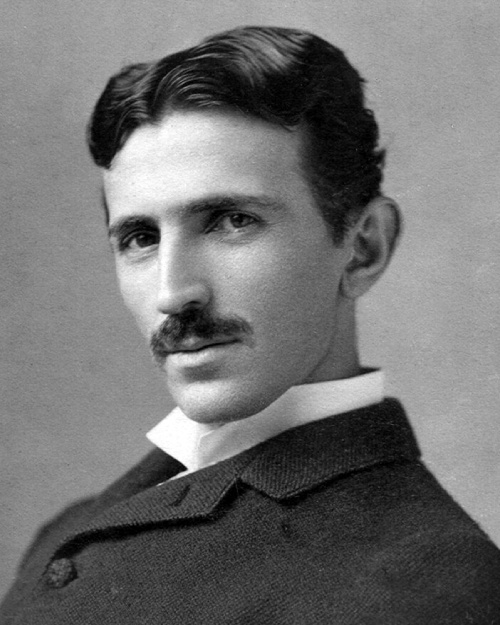
Nikola Tesla was one of the great visionaries of science. He developed the alternating current system, which became the global standard for distributing electrical power, allowing electricity to be transmitted efficiently over long distances. He also contributed to the principles of wireless communication, envisioning an interconnected world long before the digital age. His legacy continues to inspire innovations that shape the future of energy and technology.
Enjoyed this? Keep reading the other articles. The topics are related, but they do not follow a specific order.
Share this article:

Enjoyed this? Keep reading the other articles. The topics are related, but they do not follow a specific order.
Share this article: