
Duality is a constant in our reality. We live immersed in a dual world, where everything seems to exist in pairs that complement and balance each other. Everything that exists can be understood through its opposite: light does not exist without darkness, heat does not exist without cold, life does not exist without death, happiness does not exist without suffering.
Think for a moment about the relationship between light and shadow. If the universe were made only of light, there would be no distinction between objects, colors, or depth. Without shadow, light would lose its meaning; without light, shadow would not even exist. More than opposites, light and shadow are complementary, one gives meaning to the other.
Duality is so intrinsic to reality that it is almost impossible to imagine a world without it. Without opposites, there is no room for contrast, diversity, tension, transformation, and evolution. It is the foundation of our own universe and perhaps the first creative manifestation of the intelligent and omnipresent principle whose wisdom gave rise to the natural laws that govern everything from the cosmos to the quantum world.
From the very beginning, the intelligent principle that governs the universe left its signature. And in such a subtle way that it is hard to attribute it to chance. When the cosmos was still just a fraction of a second after the Big Bang, particles of matter and antimatter began to emerge in pairs—opposite in charge but identical in mass. When they met, a particle and its antiparticle annihilated each other, releasing pure energy. However, something extraordinary happened: a tiny asymmetry — about one extra particle of matter for every 10 billion antiparticles. A small deviation that made all the difference and allowed existence to continue.
After the great annihilation between matter and antimatter, this small surplus of matter was what remained… and it is precisely from it that everything we know is made: stars, galaxies, planets, atoms, and even our own bodies. This almost imperceptible difference was essential for the universe not to collapse into pure light and vanish. Perhaps behind the apparent initial chaos, there was a master plan, a subtle structure, an invisible code that allowed permanence, evolution, and complexity.
From that moment on, more polarities began to emerge: hot and cold, dense and rarefied, gravitational force and the expansion of space… Duality emerged as a way of separating, contrasting, and organizing. As if the cosmos, by dividing itself into opposites, were drawing the outlines of its own existence.
But this division was not enough. The mere existence of opposites does not guarantee harmony. Something more was needed: a process capable of integrating these contrasts, testing them, confronting them, and refining them. With time as its ally, evolution guided duality from chaos to balance, making the entire universe rests on precise interactions between opposing forces—from the macrocosm down to the quantum level.
The cosmic web, for example—a gigantic network connecting billions of galaxies in filaments of matter—is sustained by the opposition between gravity (which attracts) and dark energy (which expands). This structure is not random: it reveals patterns of balance formed by extreme contrasts between density and emptiness. Super-dense regions where galaxies cluster are interspersed with vast cosmic voids where there is practically no matter. This is duality manifesting in the very fabric of space.
Within stars, duality is expressed in the balance between gravity, which compresses matter inward, and nuclear reactions, which push outward, maintaining stability for billions of years. In this extreme environment, the simplest elements, such as hydrogen and helium, fuse into heavier atoms—carbon, oxygen, iron—forming the essential building blocks of life. When fuel runs out, the star collapses and explodes as a supernova, scattering throughout the universe the fundamental ingredients of life.
The duality within stars is not just a physical phenomenon. It is the very expression of cosmic life: the tension between opposing forces, seeking balance, generates transformation and creates something new. This cycle repeats itself, enabling the formation and evolution of increasingly complex forms, until it arrived at us—who are made of stardust.
On our planet, duality continued its creative work. Day and night, heat and cold, light and shadow provided the necessary conditions for the emergence and evolution of life. Cycles that seem simple—such as the alternation between light and dark, wet and dry, cold and hot—regulate Earth’s environment, fostering favorable conditions for simple organisms to become progressively more complex.
Even the foundation of organic chemistry that sustains life is immersed in duality: positive and negative charges allow the formation of stable and highly complex molecules, essential for the existence of the first living cells. Without this precise and constant interaction between opposite charges, the chemistry of life could never have emerged.
Continuing our journey exploring duality from the macrocosm and now arriving at the microcosm, the dual nature of our universe continues to astonish. At the quantum level, subatomic particles such as electrons or photons sometimes behave like particles, sometimes like waves—depending on how they are observed.
Now leaving the outer world and entering our inner world, this dance between opposites seeking balance continues… Our thoughts, emotions, instincts, and dreams also live in polarity: light and shadow, reason and intuition, fear and courage. Life invites us, at every moment, to seek a new point of balance—not by eliminating opposites, but by integrating them more consciously.
Just as the universe moved from chaos to balance, we too are invited to evolve through the tensions of duality. It is not about choosing one side and rejecting the other, but about finding meaning in the interaction between both. Allowing the friction between opposing forces to transform us, refine us, and expand us. Duality allows us to experience contrast and to know light through shadow, happiness through pain, peace through war, love through indifference.
Opposing poles are nothing more than two sides of the same coin—they seem separate, but in essence, they are complementary manifestations of the same whole. Perhaps duality is one of the ways in which the source of creation that drives the universe invites us to evolve, breaking inertia and expanding our consciousness.
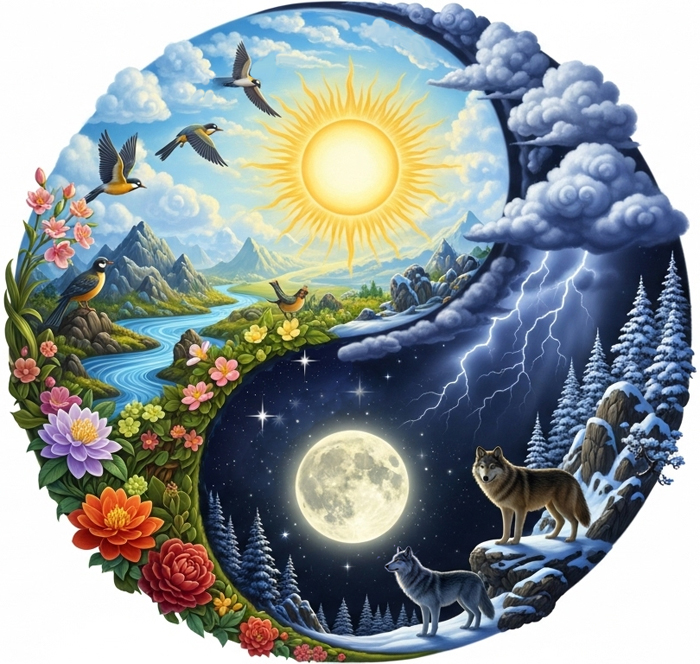
In Chinese philosophy, the Yin-Yang symbol represents the harmonious interaction between opposing forces. Yin is the dark, the receptive, the cold. Yang is the light, the active, the warm. Nature reflects this balance: day gives way to night, winter prepares for spring. Everything transforms through the continuous alternation between complementary opposites.
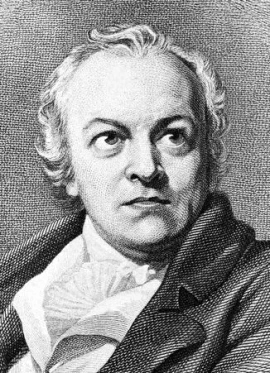
“Without contraries is no progression”
William Blake
English poet, painter, and printmaker of the 18th and 19th centuries
This idea is central to his work and philosophy, especially in “The Marriage of Heaven and Hell” (1793). In this work, Blake argues that the tension and opposition between seemingly opposite forces (such as reason and energy, good and evil, angels and demons) are not only necessary but also the very source of creativity, life, and true progress. For him, repressing one side in favor of the other leads to stagnation, while interaction and conflict between them generate movement and evolution.
Cultural Duality
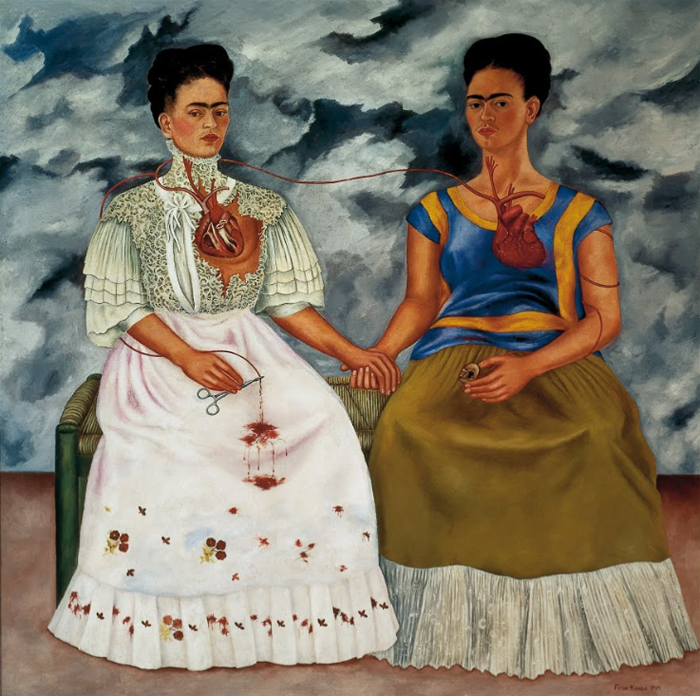
The painting “The Two Fridas”, created by Frida Kahlo in 1939, powerfully and sensitively illustrates the duality that inhabits every human being. Painted during a period of profound emotional pain, after her divorce from Diego Rivera, the work expresses the artist’s internal division between two identities that coexist in tension. On one side, Frida dressed in European attire, with her heart open and bleeding, symbolizes pain, rejection, and the conflict with her Western heritage and the loss of love. On the other, Frida in traditional Mexican clothing keeps her heart intact, representing her Indigenous roots and the inner strength that sustains her. Both are connected by a pulsating vein — a symbolic thread of belonging and shared suffering.
The painting thus becomes a powerful visual metaphor of cultural and emotional duality that inhabits not only the artist, but all of us. In Kahlo’s characteristic style, which blends realism, symbolism, and touches of surrealism, the work reveals the internal contrasts of the human soul: reason and emotion, fragility and strength, rupture and belonging. This oil on canvas is exhibited at the Museo de Arte Moderno in Mexico City.
The Yin-Yang and the Eight Trigrams of the Bagua
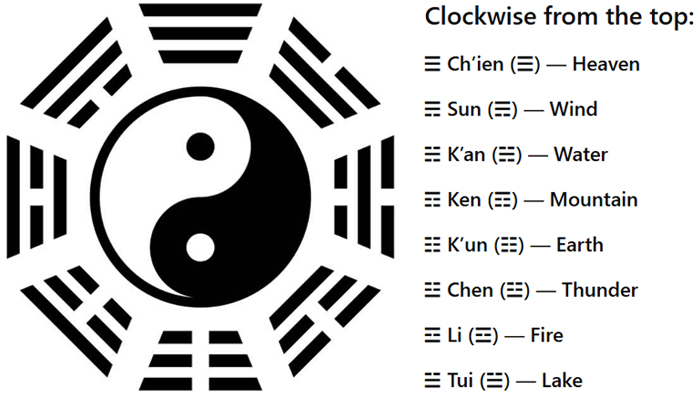
In the image, the central Yin-Yang symbol is surrounded by the eight trigrams of the Bagua — fundamental elements of Taoist thought and the structural foundation of the I Ching, the Book of Changes. Each trigram is composed of three lines — either solid or broken — representing essential forces of nature in dynamic interaction. Together, these symbols express the harmony between complementary opposites, reflecting the natural cycles and the principles that govern life, the human body, emotions, and the cosmos itself. Their arrangement around the Yin-Yang reinforces the idea that all duality exists within a larger system of balance and continuous transformation.
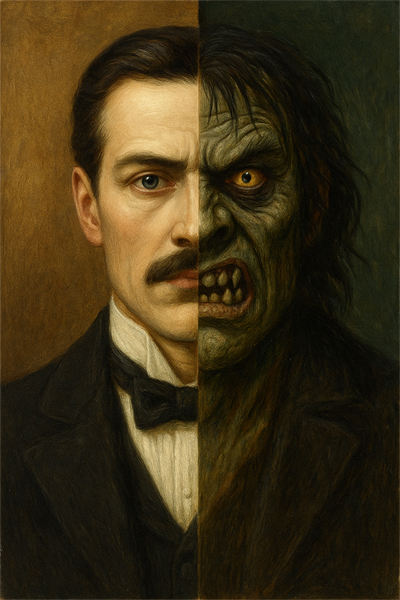
The work The Strange Case of Dr. Jekyll and Mr. Hyde, written by Robert Louis Stevenson in 1886, is one of the most iconic representations of human duality in literature. The narrative revolves around the respectable Dr. Henry Jekyll, who develops a formula capable of separating his dark impulses into a second personality: the violent and uncontrollable Mr. Hyde. The story brilliantly exposes the conflict between reason and instinct, morality and desire, light and shadow — revealing that within each individual exist opposing forces in constant tension.
Enjoyed this? Keep reading the other articles. The topics are related, but they do not follow a specific order.
Share this article:

Enjoyed this? Keep reading the other articles. The topics are related, but they do not follow a specific order.
Share this article: