
We live in a space of “only” three dimensions. This has been known since the time of Euclid, the Greek considered the father of geometry. To understand, just look around. We can go forward and backward, left and right, up and down. Any other direction is just a combination of these three.
But are these the only three dimensions? It is worth remembering that something does not cease to exist simply because we cannot see it. Even if, in our three-dimensional way of living, we cannot perceive the dimensional boundaries around us, we are still able to sense them and even imagine them.
Some examples help to explore these boundaries.
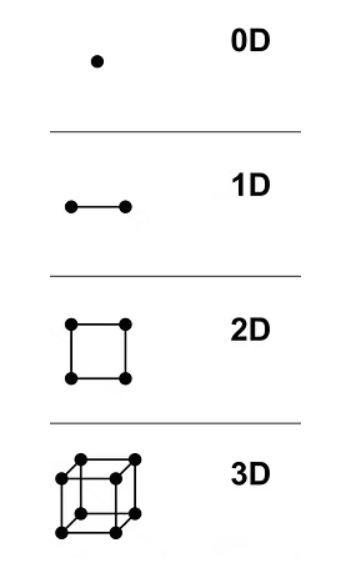
Zero-dimensional: think of a point. It can be on a sheet of paper, in space, or representing the singularity before the Big Bang. A point is just that. It does not move, it has no size, no volume, and no time. It simply exists, motionless and timeless.
One-dimensional: a good example is a train on tracks. It can only move in one direction, following a line. For this train, there are only two options: move forward or go back. Nothing more.
Two-dimensional: here we can think of a video game character in a soccer game, or billiard balls on a table. The character moves in a plane. It can go sideways or forward and backward, but there is no possibility of going up or down. There is no button that makes it shoot upward or sink into the ground. And if you tried to explain this to the character, it probably would not understand, since “above” and “below” simply do not exist in its reality.
Three-dimensional: this is our reality. We live in three spatial dimensions. And perhaps, in a higher dimension, there is a being trying to explain our world to another “simpler” being, with the same difficulty we would face explaining depth to a video game character.
It is easy to grasp the limitations of the point, the train, or the video game character, because these dimensions are contained within ours. But trying to imagine a fourth or fifth spatial dimension is an immense challenge. In fact, even our perception of 3D space is limited. Our eyes capture images in two dimensions, and it is the combination of these two images in our brain that allows us to perceive depth and form a three-dimensional vision. Perhaps if we had extra senses, like the sonar of dolphins or bats, we would perceive the world in an even richer way.
Since it is so difficult to imagine a dimension beyond our own, we can look for clues within what we already know. Mathematics offers us some. A point has no dimension. A line is bounded by two points. A square, in turn, is bounded by four lines. A cube is bounded by six squares. Following this logic, a hypercube would be bounded by eight cubes.
It is even possible to represent a hypercube by drawing a cube inside another cube and connecting their vertices. However, what we manage to draw is just a static projection. Just as the shadow of a cube on a flat surface is a 2D form, what we represent of a fourth-dimensional object is only its shadow projected into our three-dimensional space.
Although we live in a 3D space, our reality is composed of four dimensions. We must add time. For example, you can locate any point on a map using latitude and longitude. But to find an apartment, you also need height. And if you want to arrange a meeting, you must also include the time. That is the role of the fourth dimension: time.
Until the early 20th century, space and time were considered separate things. It was Einstein, with his Theory of Relativity, who showed that they form a single structure: space-time. From that moment on, time came to be understood as a dimension as real as the others.
This vision revolutionized science. It was discovered that space can curve, that time can dilate, and that all of this depends on gravity and the speed at which we move. The universe ceased to be something rigid and absolute. It came to be understood as a flexible fabric, shaped by matter and energy.
With the progress of studies on the subatomic world, Quantum Mechanics was born. This new approach revealed even stranger behaviors. Some particles can be in several places at the same time, and others change their behavior when observed. To unify these ideas with Relativity, theories such as Superstrings emerged, proposing that the universe is made up of tiny strings vibrating in dimensions beyond the four known ones. Some of these theories speak of ten or even more dimensions.
Science is still seeking to confirm whether these extra dimensions really exist. They may be folded in on themselves, hidden at microscopic scales. Even if invisible, they may be the key to understanding the deepest structure of reality. Perhaps the space we perceive is not the foundation of the universe. It may be that there is something subtler, like the mathematical patterns of quantum physics.
Returning to the exercise of imagination, think of a little ball living in a two-dimensional world, like an infinite billiard table. It can move in four directions: north, south, east, and west. That is its entire reality. If we, three-dimensional beings, stacked one ball on top of another, the one below would see the one above disappear. For it, the concept of “above” does not exist. And the one on top, upon leaving the perceptible plane, would feel as if it were in a point without reference. A total void.
Now imagine you have a friend from the fourth spatial dimension. You cannot see him, for he exists in a reality inaccessible to your senses. Perhaps you would hear him as a voice that seems to come from all sides, or even from within yourself. Suppose you are in a warehouse full of boxes and need to organize them. A huge task. If you asked your friend for help, you would see the boxes appearing and disappearing quickly, moving back and forth into a place you cannot perceive. You would see the changes happening, but you would not be able to see who caused them or how.
If dimensions beyond ours exist, what would those universes be like? Would they be timeless? Would they have multiple layers, like an onion? Would they be rolled up like tubes within tubes? Or perhaps it would be possible to pull an invisible thread and turn all of reality inside out?
Think about this before you fall asleep tonight. Trying to imagine these possibilities with a 3D mind is not an easy task.
Perhaps our difficulty in conceiving other dimensions comes from the fact that we evolved within a limited context of space-time.
It may be that we are constantly crossed by other, subtler realities. We just do not perceive them. But that does not mean they do not exist.
The Father of Geometry
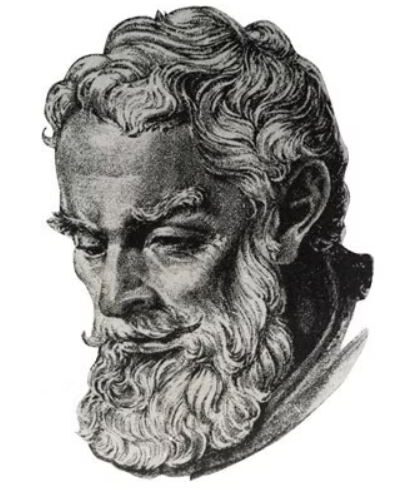
Euclid of Alexandria was a Greek mathematician and writer, regarded as the greatest figure in Ancient Greek mathematics. His name in Greek, Eukleidēs, can be translated as “renewed” or “glorious.” Known as the “Father of Geometry,” he taught at the Royal School of Alexandria, an academy founded by Ptolemy. His intellectual production was vast, not only because of his own contributions but also due to his leadership of a team of mathematicians whose works continued to be published under his name even after his death. His masterpiece, The Elements, is composed of thirteen books organized as a sequence of theorems that still serve as the foundation for the study of geometry today.
Spatial Dimensions
Hypercube
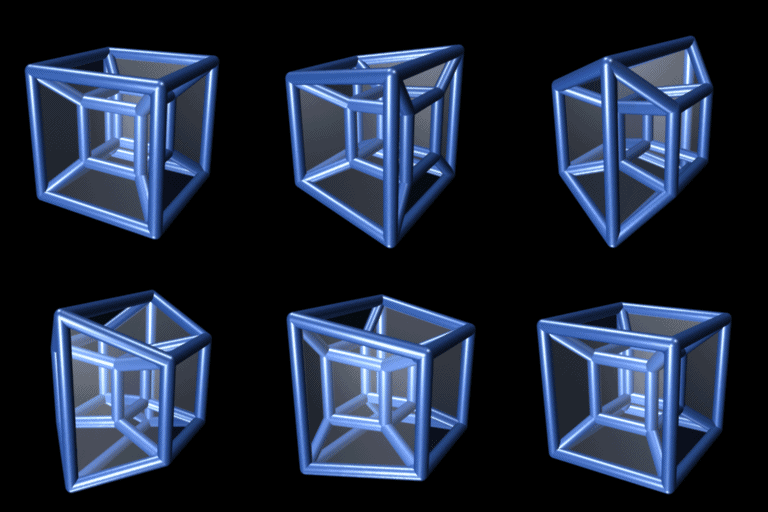
3D projection of the shadow of a hypercube performing a simple rotation around a plane that cuts the figure from front to back and top to bottom. A hypercube, also known as a tesseract, is the four-dimensional version of a cube. Just as a square is formed by connected lines and a cube by interconnected squares, the hypercube is composed of cubes connected to each other in a higher dimension. Although it is impossible to fully visualize it in our three-dimensional world, we can represent it through projections, just as a 2D shadow can suggest the form of a 3D object. The hypercube is a powerful example of how mathematics allows us to extend concepts beyond sensory perception, helping us imagine structures that transcend the limits of the space we know.
Radioactive toothpaste

Sold as miraculous in Germany in the 1920s. The world was a different place before humanity understood the particularities of the subatomic world.

“The laws of nature are but the mathematical thoughts of God.”
Johannes Kepler

Enjoyed this? Keep reading the other articles. The topics are related, but they do not follow a specific order.
Share this article:

Enjoyed this? Keep reading the other articles. The topics are related, but they do not follow a specific order.
Share this article: