
We usually think of matter as what “fills” empty space. We live surrounded by a reality that seems solid, dense, tangible. We touch, see, build, and shape the world around us as if it were made of a concrete substance. But when we zoom in closer and closer to the fundamental particles of matter, we discover something surprising: what we call matter is, in fact, almost nothing. Matter is essentially made of emptiness.
Most of the volume of an atom — about 99.999% — is empty space. Although the atomic nucleus, which contains protons and neutrons, is extremely dense, it is tiny compared to the overall size of the atom. To illustrate: if an atom were the size of a football stadium, its nucleus would be like an ant at the center of the field.
To truly understand the atom, we must move beyond the simplified model we learned in school. In that model, the nucleus is surrounded by electrons orbiting like planets around the Sun. This image is intuitive, which is why it still appears in many textbooks, but science has known for over a century that electrons are not little balls circling the nucleus.
A more accurate way to imagine an electron is as a diffuse cloud of energy around the nucleus, not as a particle with a defined position. When two atoms approach to form a molecule, these clouds interpenetrate, creating an even wider and subtler shared region. And when you touch a surface, what happens is not direct contact between solid particles, but an interaction between electromagnetic fields. The electrons of the surface atoms repel the electrons of the atoms in your skin, making those clouds adjust, compress, and shape themselves to one another. That is what generates the sensation of touch.
This “emptiness” that makes up nearly all the volume of an atom is not absolute vacuum. It is not total silence or the complete absence of anything. In fact, it is dynamic and active, filled with what modern physics calls quantum fields. These fields are like invisible fabrics that permeate all of space, even where no “real” particles are present. Within them, virtual particles — such as photons — constantly appear and disappear, existing only for fractions of a second and never directly observable. Yet, they leave measurable effects and subtly but fundamentally influence matter.
These virtual particles are responsible, for instance, for the electromagnetic forces that keep atoms cohesive. Even when no visible electrons are moving, the surrounding fields still vibrate with potential. The way they move, interact, and occupy space is governed by the laws of quantum mechanics. These laws state that two electrons cannot occupy the same quantum state at the same time, and also that their position and velocity can never be known with complete precision.
And that is just the beginning. Contemporary physics goes even further. Some theories suggest that the entire universe might be a holographic projection. In this case, what we perceive as three-dimensional matter would only be the manifestation of information encoded on a two-dimensional surface. Other hypotheses, such as String Theory, propose that all particles are actually vibrations of tiny one-dimensional strings oscillating in extra dimensions invisible to our senses. In this view, matter would be like music vibrating in the silence of the vacuum.
There are also ideas that sound close to science fiction, but are part of serious discussions at the frontiers of theoretical physics. Among them are parallel universes, mirrored realities, hidden dimensions, and wormholes, which could connect distant regions of space-time. All these possibilities arise from the bold attempt to unify Einstein’s Theory of Relativity, which describes the universe at large scales, with quantum mechanics, which governs the behavior of the microscopic world. Matter, in this context, is just one of the faces of a far more complex cosmic fabric, where energy, space, time, and information interweave into patterns we are still far from fully understanding.
Perhaps everything we know — and even our very reality — is just a small excerpt of a great and masterful symphony that, for now, we are only beginning to hear.
Hydrogen Atom
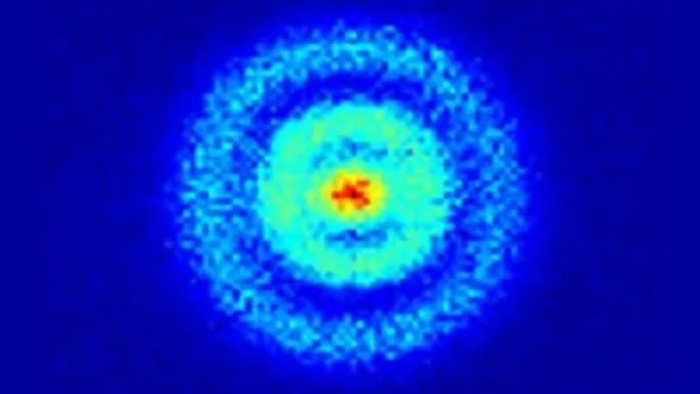
This scientific photograph shows the electron cloud of a hydrogen atom, the simplest of all, composed of a single proton and an electron. The central red point marks the nucleus, while the bluish rings reveal where the electron is most likely to be found. Instead of orbiting in fixed paths like planets, the electron behaves as a diffuse cloud of possibilities, just as quantum mechanics predicts.
It is the first direct representation of the wave function of an electron in a hydrogen atom, obtained in 2013 by scientists from the FOM Institute using ultraviolet laser photoionization. By measuring the trajectory of excited electrons ejected by the light, the researchers reconstructed the probability cloud predicted by quantum mechanics. The study was published in Physical Review Letters and marked a historic breakthrough in the visualization of atomic structures.
String Theory
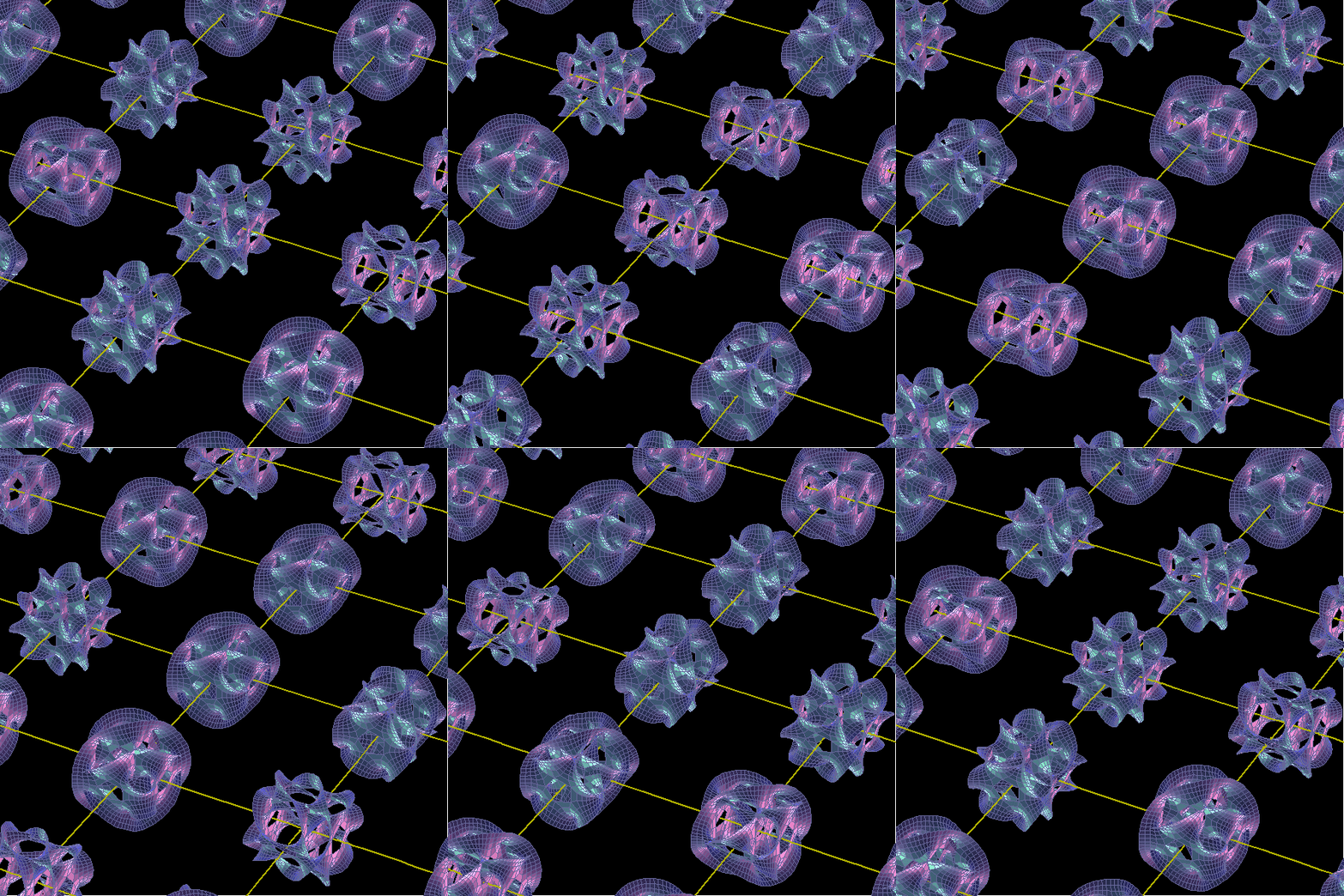
String Theory is a proposal in theoretical physics that seeks to unify all the fundamental forces of nature into a single model. Instead of treating subatomic particles as structureless points, it suggests that these particles are, in fact, tiny vibrating strings of energy. Each type of vibration corresponds to a different particle, much like different notes can be produced by the same violin string. For this theory to work mathematically, it requires the existence of extra dimensions beyond the three of space and one of time — usually a total of ten or eleven dimensions. Although it has not yet been experimentally proven, String Theory remains one of the main candidates for the so-called “theory of everything,” which aims to reconcile general relativity (describing the universe on large scales) with quantum mechanics (governing the microscopic world).
Dark Matter
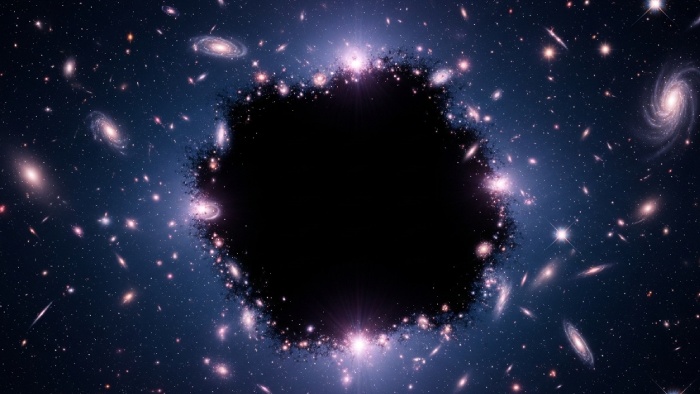
Dark matter is an invisible form of matter that scientists know exists because of the gravitational force it exerts, but whose exact nature is still unknown. It neither emits nor reflects light, which makes it difficult to detect directly. The idea emerged in the 1930s, when astronomer Fritz Zwicky noticed that the observed mass of certain galaxies was far too small to explain their gravitational behavior, suggesting the presence of a large amount of unseen matter. It is estimated that dark matter makes up about 95% of the Universe, and is possibly composed of subatomic particles that have not yet been detected. It is important to emphasize that, despite its name, it has no relation to black holes.

Enjoyed this? Keep reading the other articles. The topics are related, but they do not follow a specific order.
Share this article:
Enjoyed this? Keep reading the other articles. The topics are related, but they do not follow a specific order.
Share this article: