
We live in a universe made of contrasts. Just as there is light and shadow, sound and silence, heat and cold, we also experience good and evil. But unlike physical phenomena, these last two are not just external realities. Rather, they dwell mainly within us. They are concepts that define, question, and challenge our ethical sensibility.
Light does not judge shadow. Cold does not condemn heat. But we, humans, judge our actions, feelings, and intentions. The duality between good and evil is born from the ability to reflect, evaluate, and choose. It does not exist in the elements of nature, but in our self-awareness.
While the physical universe operates with mathematical precision, the human universe is driven by ethical dilemmas. Because we are conscious beings, we can ask: “Is this right?”, “Is this fair?”, “Does this do good or harm?”. This ability is both a gift and a responsibility. It is what makes us human. It is what brings us closer to, or distances us from, the divine.
Good and evil form a moral duality. Unlike the forces of nature, which merely coexist, this duality arises from within the human being. They are internal projections, built from our values, cultures, emotions, and experiences. The same act can be seen as virtuous or condemnable, depending on the intention, the context, and the perspective of the observer.
It is not pleasant to see a gazelle cub being devoured by a lion. The scene may cause us discomfort, sadness, or disgust, but that does not mean it is “evil.” The lion does not act out of cruelty; it simply follows its nature. It evolved as a predator, with teeth, claws, and instincts that enable it to hunt. In doing so, it fulfills its role within the ecosystem, controlling populations, maintaining balance, and paradoxically contributing to the health of the environment.
Nature, over millions of years, has adjusted its own mechanisms of balance. The food chain, the cycles of life and death, predators and their prey, all are part of a complex and interdependent system. And in that, there is no judgment.
The universe itself does not judge. A volcano erupting may destroy a forest, but that is not evil. A star may explode and create new galaxies, but that is not good in the ethical sense. Nature simply is, without guilt, without merit.
The human being, however, is different. We are endowed with self-awareness. We think about our actions, evaluate their effects, feel remorse or pride. We have notions of justice, duty, compassion, responsibility. We are the only beings, as far as we know, capable of saying: “This is right” or “This is wrong.” This capacity for judgment is what creates moral duality.
Good and evil, in this context, are not absolute and universal forces like gravity or electricity. They are constructions of the human mind, shaped by experiences, feelings, philosophies, and traditions. What is considered “good” in one culture may be seen as “evil” in another. Yet the existence of this inner duality is almost universal, indicating that it is deeply rooted in our shared humanity.
Despite cultural differences, there are values that seem to transcend borders. Protecting life, respecting others, seeking justice, relieving suffering. These ideas appear, in different forms, in practically all spiritual and philosophical traditions. This suggests the existence of a deeper ethic, a kind of inner compass pointing to a “good” that goes beyond conventions.
Sometimes this compass is well calibrated. Other times, misaligned by traumas, limiting beliefs, or difficult circumstances. But it exists. When we do something that harms others, or ourselves, we feel discomfort. When we help, embrace, or forgive, we feel relief, expansion, peace. These sensations are not random. They point the way.
This compass can be called conscience. It is what whispers when we are about to act unjustly. It is what unsettles us when we ignore another’s pain. It is what urges us to be better, even when no one is watching.
To be good is not to be perfect. It is not to never make mistakes. It is to be willing to learn, correct, and evolve. It is to recognize that we all have light and shadow, and that by accepting this duality, we can integrate it with wisdom. Denying the evil within us is dangerous. Understanding its origin is the first step toward transforming it.
If the universe was created by a higher intelligence, as many traditions suggest, good may be a kind of moral gravity: silent, but present in everything. Evil, in this context, would be a form of resistance, a momentary imbalance that challenges us to evolve.
Pain awakens us. Injustice mobilizes us. The absence of love makes us seek it more intensely. We evolve because we are challenged. We grow because we face the shadow. Perhaps evil is the necessary contrast for good to shine more clearly, like the night that helps us value the sunrise.
Perhaps the true evil is the inertia of consciousness: refusing to see, change, or act. Evil would be the stagnation in the face of life, going against one of the most fundamental laws of the universe — the law of evolution.
Everything in the cosmos transforms, gains complexity, evolves. And we too are called to do the same.
Visual Archetypes of Moral Duality
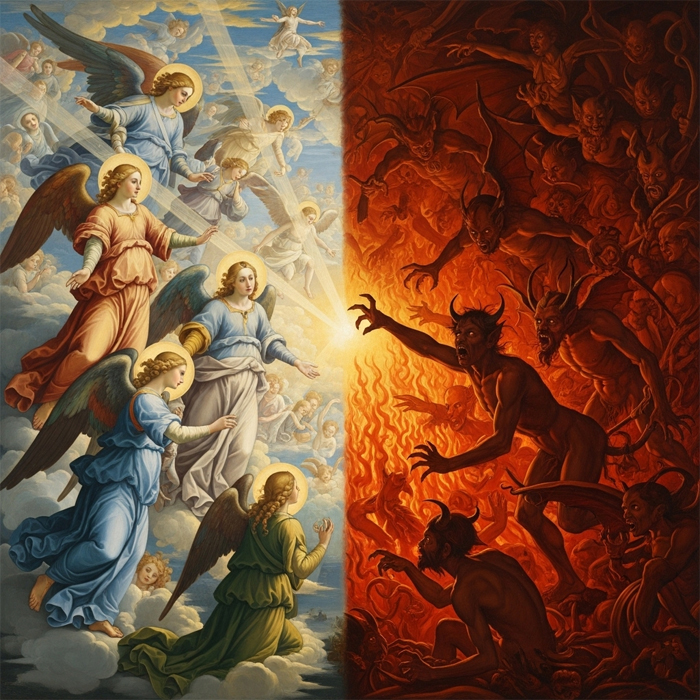
Since the Middle Ages, art began to portray good and evil through symbolic figures such as angels and demons. Angels — luminous, serene, and ethereal — embodied purity, grace, and divine order. Demons, on the other hand, deformed and shrouded in shadow, symbolized chaos, sin, and spiritual downfall. Over time, these figures became visual archetypes of humanity’s moral duality, reinforcing the idea that the spirit is always caught between choices — ascension or fall, light or shadow. This symbolic opposition expressed the traditional view of a constant battle between light and darkness, so central to the Christian worldview of the time.
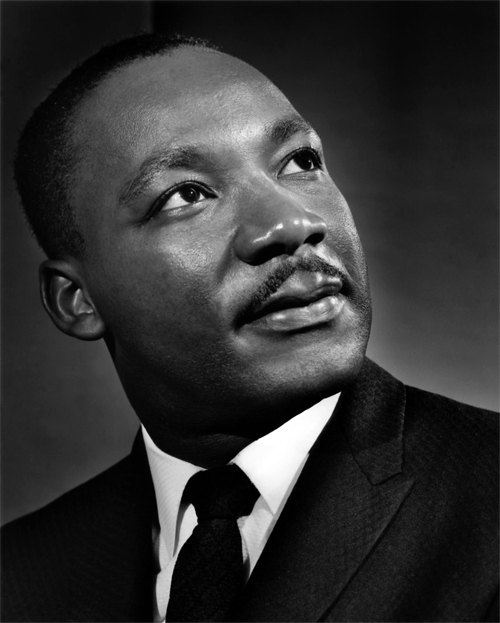
“Darkness cannot drive out darkness; only light can do that. Hate cannot drive out hate; only love can do that”
Martin Luther King Jr.
He was one of the greatest leaders of the civil rights movement in the United States. This quote encapsulates his philosophy of nonviolence and love as tools to confront injustice and hatred.
From the Ashes, Evolution
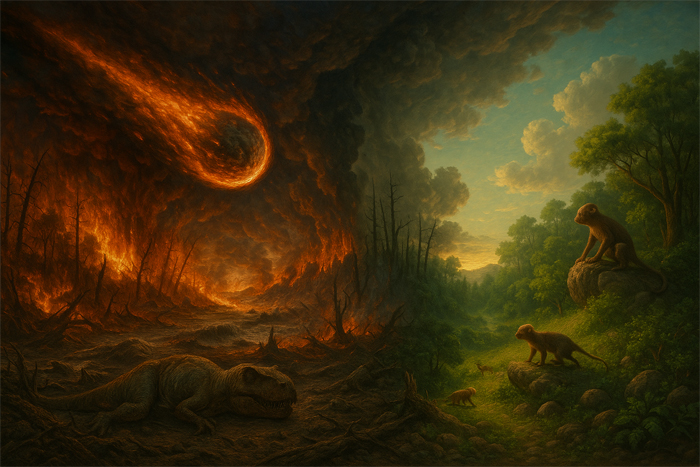
About 66 million years ago, an asteroid caused the extinction of the dinosaurs and forever changed the history of Earth. It was destruction on a planetary scale — but it paved the way for a new stage of life. Mammals, once secondary, thrived. And after millions of years of evolution, humans emerged. In nature, end and beginning are not opposites, but parts of the same flow. The fall of one world can be the birth of another.
Masters of Light
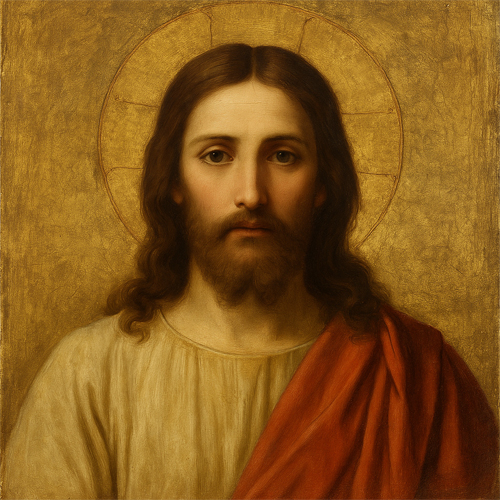
Jesus Christ
Jesus is the expression of divine love in human form. His teachings on compassion, forgiveness, and humility changed the course of Western history. Even outside Christian theology, he is regarded by many as an enlightened master and a universal moral guide.
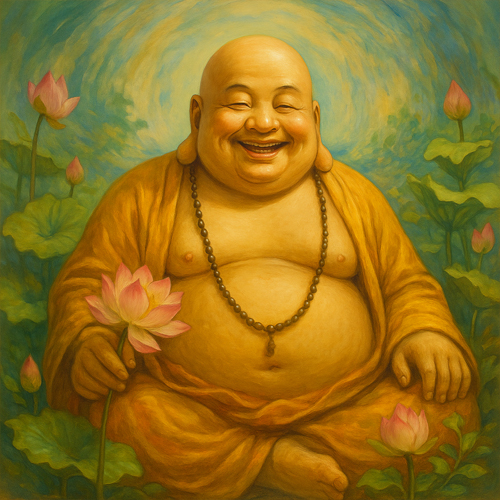
Buddha (Siddhartha Gautama)
He renounced his life as a prince in search of the end of suffering. Upon attaining enlightenment, he became the Buddha, the “Awakened One.” His teachings gave rise to one of the most influential spiritual traditions, showing that liberation is possible for all.
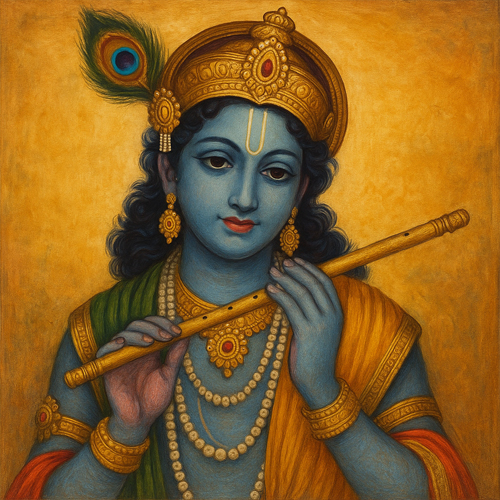
Krishna
In Hinduism, Krishna is considered a direct manifestation (or avatar) of Vishnu, the preserving aspect of the divine trinity, responsible for maintaining cosmic order. For many Hindus, Krishna is not just an enlightened being but God incarnate, a divine presence who teaches, protects, and guides humanity through his wisdom and actions.
Enjoyed this? Keep reading the other articles. The topics are related, but they do not follow a specific order.
Share this article:

Enjoyed this? Keep reading the other articles. The topics are related, but they do not follow a specific order.
Share this article: