
Our life is uncertain. Many things can happen during our existence. The branches, whether by choice or circumstance, are practically infinite. Life can be full of achievements and happy moments, but it can also be marked by suffering and difficulties. Everything depends on many factors: the family we are born into, the type of society we belong to, the time in which we live, the education we receive… But of one thing we are sure: no matter how varied the paths we take, the end is always the same. Death.
For some, death is something terrifying. The turning off of the lights. The end of everything, including consciousness itself. For others, it is only a change of state, the beginning of a new form of existence, free from a material body. Most people remain in a middle ground: they know it is a one-way journey, but intuit that something continues to exist beyond biological death.
This idea of what persists after death can vary greatly: the DNA passed on to descendants, the legacy left in the world, an immortal spirit… Here we can include everything that is the immaterial part of a being that, in some way, will continue to exist after the end of the physical body.
All religions, although they do not share the same concept of soul, speak of an essence that transcends the body. In Greek tradition, psyche was the soul, also understood as “mind” or “vital breath.” In the East, Hindus speak of the atman, the Higher Self. In Ancient Egypt, the soul was composed of several parts, such as the ba (personality) and the ka (vital force). In the Christian West, the soul came to be seen as the immortal part of the human being, which survives the death of the body.
Even modern science, so focused on matter, has stumbled upon mysteries that make us reconsider ancient ideas. Quantum physics shows that reality, at its foundation, is made of possibilities, not certainties, and that the observer influences the observed. This suggests that consciousness, this ‘something’ that witnesses experience, may not be just a product of the brain, but an active presence in the fabric of reality of which we are part.
This text does not intend to tell you what you should or should not believe, but only to invite reflection. It is reasonable to admit that there are many things we still do not understand, both about the external world and about our inner universe. We are too complex to reduce everything to black and white, without shades of gray. And even with all this complexity, we are far from being complete. Our experiences, beliefs, and values, no matter how rich, are just ways of seeing and interpreting reality.
Perhaps, instead of deciding whether something exists or does not exist, or whether it is right or wrong, it is wiser to think in terms of possibilities and let our logic, faith, instinct, and emotions filter what makes sense to us.
From this principle, let us explore a possibility of the existence of the “soul,” even under the lens of traditional science, which does not recognize it as something proven or measurable, and generally considers that consciousness, identity, and emotions emerge from brain activity.
Several experiments have already shown that the brain emits electrical signals, and science is already capable of recording and decoding these signals, mapping specific areas responsible for cognitive and motor functions. We have already seen cases in which monkeys, and even humans with brain implants, interacted with computer screens using only thought, moving a cursor without any physical movement.
These advances belong to the field of neurotechnology and show that our thoughts, or more precisely, the neural impulses associated with intentions and decisions, can be translated into external actions through algorithms. There are already robotic arms directly controlled by the mind, and companies like Neuralink are developing increasingly sophisticated brain-computer interfaces, with applications ranging from the treatment of neurological diseases to the expansion of human cognitive abilities.
Technology is advancing fast! And this kind of thing is impressive. Moving something at a distance sounds almost paranormal, doesn’t it? Science, at its frontiers, begins to converge with the fantastic and with subjects once considered taboo outside of mysticism, spirituality, or philosophy.
Let us then imagine the soul from the most classical scientific view, the one that affirms that everything, including consciousness, is generated exclusively by the brain. Suppose that, in a distant future, the advance of science allows us to perfectly understand neural impulses and the entire functioning of the human brain: both the processing of external stimuli (vision, hearing, touch, etc.) and the internal processes that generate consciousness, intelligence, and emotion.
What we already do today, such as overcoming physical limitations with implants, would be only the beginning. The next step will be to improve what we already have: more efficient bodies, amplified senses, replaceable parts ranging from limbs to sensory organs. And we are not talking about a metallic, cold, and mechanical cyborg. Technology may also preserve what is beautiful, organic, and aesthetic. Improved biological materials will replace metal, or something new, not yet invented, will emerge.
Let us imagine, then, that these advances lead to a point where the brain, according to science, the center of everything, becomes the only “original” part of our biological configuration. A brain safely preserved, functioning perfectly, and connected to an artificial body at a distance. A “boxed brain.”
This image may seem dystopian now, but let us remember: it will take many years of scientific and technological evolution before this becomes possible. And when it does, we will probably not feel like brains isolated in boxes. On the contrary, the sensory experience may be even more real than it is today. Our brain will be safe and sound, in a protected place, while we control our body remotely.
Imagine this brain free from physical limitations, connected to a network with other brains and with all the accumulated knowledge of humanity. Enhanced by an almost infinite memory and processing capacity. Let this brain evolve for thousands, or millions, of years. Since the Big Bang, some atoms have evolved until they became this extraordinary machine that is your brain. What would be the limit?
This brain, boxed deep in some indestructible bunker, will have the time and capacity to experience everything: to satisfy its most intimate desires, to live all possible forms of existence, to experience being man, woman, poor, rich, famous, anonymous, loved, lonely. After living everything there is to live, it will begin to create. Fantastic worlds, entire planets with unprecedented physical laws. It will create characters, observe their evolution. It will create life, instinct, reason, consciousness…
And what guarantees that you are not one of these characters? A creation of an immortal brain that had eternity to experiment, create, and evolve?
Calm down. Do not be frightened by this imaginary future. This thought experiment only serves to illustrate a possibility of soul, even under the perspective of traditional science. Because, in the end, if consciousness, identity, and emotions arise from the brain, it makes no difference whether the soul is a divine spark or a sequence of binary codes created by a superbrain in a box. The lived experience would be the same.
Not everything is neural impulses. Even science is revising many of its paradigms, as shown by the discoveries of quantum physics and other emerging fields. There are also things we simply feel, that we intuit as real, but that escape the reach of any instrument: emotions, faith, intuition, consciousness, love. Perhaps our soul, or essence, or consciousness, or line of code — call it what you will — is a condensed expression of something cosmic, vast, and indescribable.
Consider the possibility that perhaps we are not a body with a soul, but a soul using a body. That we may have an immortal essence, which is a fractal of the very creator experiencing its own creation. In a fractal, the whole is reflected in the parts and each part contains the pattern of the whole.
If the individual consciousness is a fractal of the universal consciousness, then by looking within oneself, the human being contemplates infinity and recognizes itself as part and expression of the eternal.
I can control computers with my mind
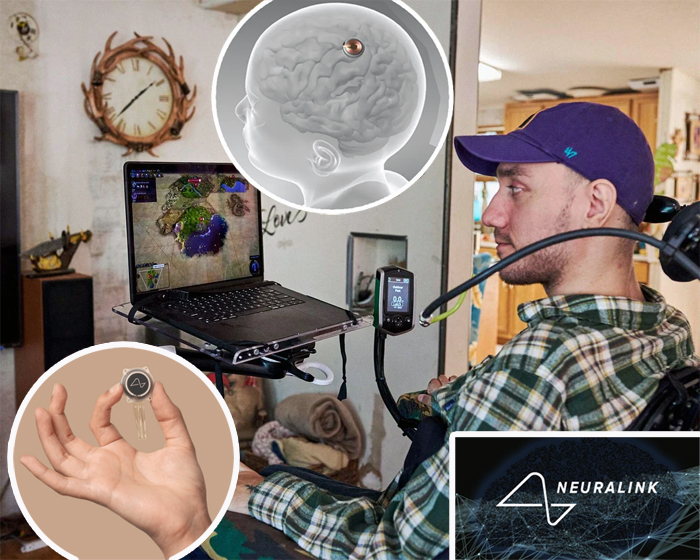
The story of Noland Arbaugh, a 29-year-old quadriplegic, marks a milestone in science. In January 2024, he became the first person to receive a Neuralink brain implant. Thanks to this chip, Noland is able to control a computer cursor using only his thoughts, as well as play video games like chess and Civilization VI, and communicate digitally — all without moving his body. The tiny implant was inserted by a robot into Noland’s motor cortex and translates neural signals into actions — such as moving the cursor on the screen — all wirelessly. Despite some initial technical adjustments, Noland described the experience as something that made him “regain the spark of life,” even comparing the sensation to using “the Force” from Star Wars.
Source Fractal
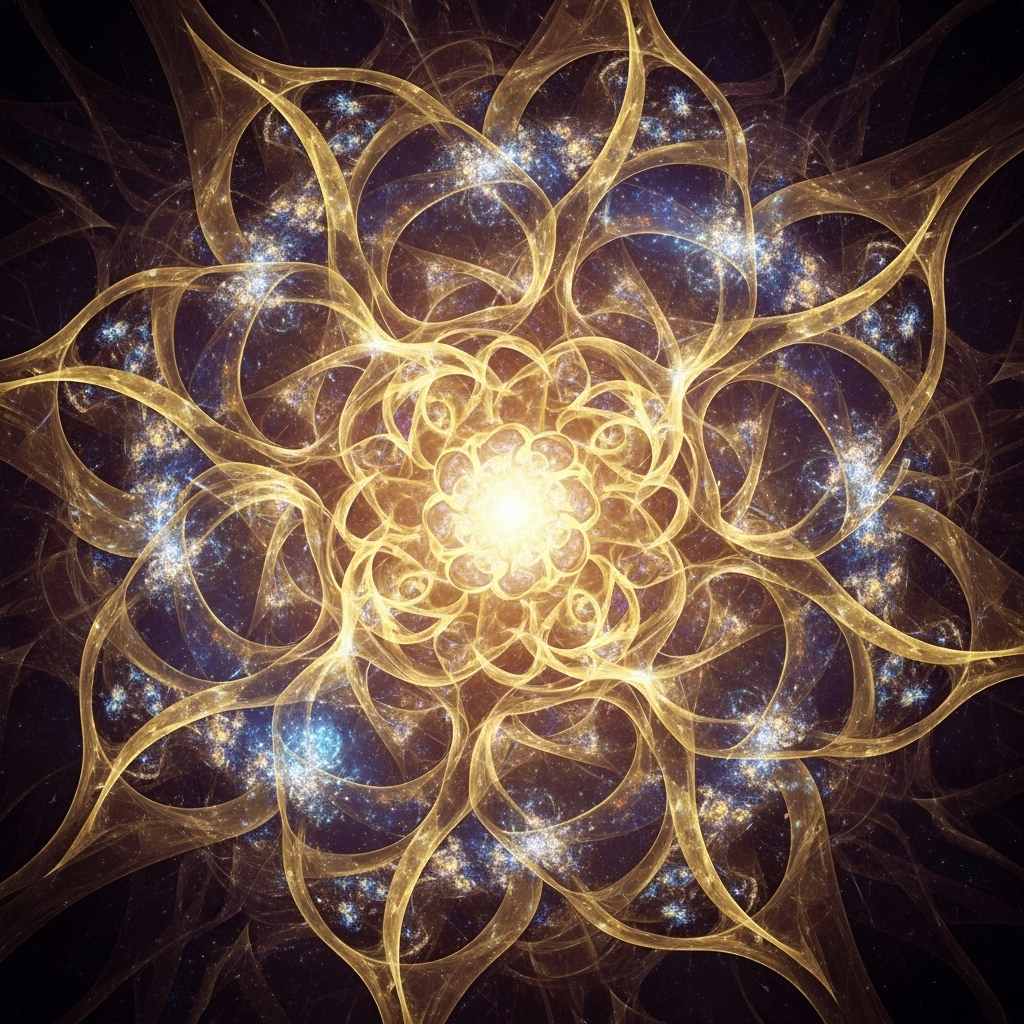
Fractals are natural patterns that repeat at different scales — from the branching of a tree to the structures of neurons in the brain. Just like a fractal, the soul can be seen as a structure that reflects the whole — a spark of infinity contained within us, carrying the very signature of the universe: evolution and constant expansion. The individual consciousness connected to the universal whole, transcending time and space.
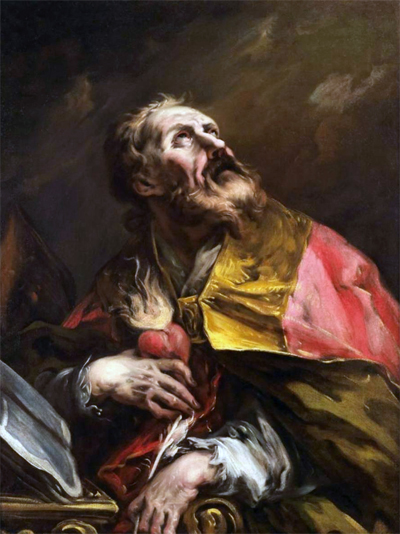
“Take care of your body as if you were going to live forever, and of your soul as if you were going to die tomorrow.”
Folk wisdom inspired by Augustinian thoughts
Augustine of Hippo
Oil on canvas, 18th century, by Giuseppe Antonio Pianca
The work conveys the reflective character of Augustine, one of the most influential thinkers in the Western Christian tradition.
A ghost in the photo
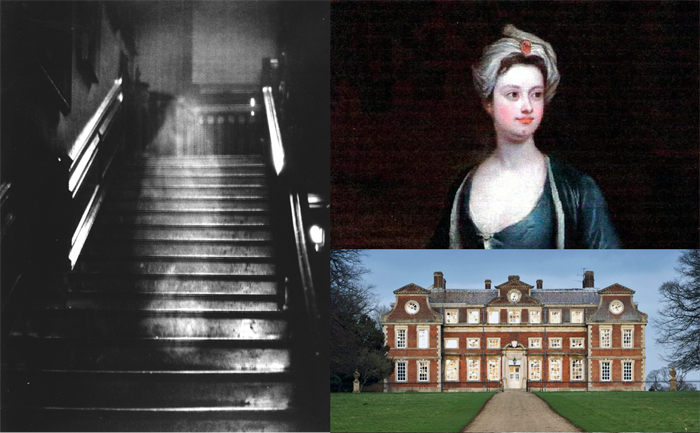
Over time, several supposedly paranormal photographs have sparked fascination and debate about the existence of the soul and life after death. Among them, one of the most famous is the “Brown Lady” of Raynham Hall, taken in 1936 by photographers from Country Life magazine. The image shows a translucent figure descending a staircase in an English mansion, identified by many as the spirit of Dorothy Walpole, an 18th-century lady. The negative was analyzed at the time by experts such as Harry Price, who found no signs of manipulation — a remarkable conclusion, considering the limited technical resources of that decade. Furthermore, the photographers themselves reported having seen the apparition at the moment of the shot. These elements, combined with the unusual sharpness of the captured form, make this photo remain one of the most intriguing visual pieces of evidence ever recorded about what may exist beyond matter. Whether the result of illusion, technical error, or something still unexplained, the image continues to provoke reflection on the existence of the soul and the mysteries that challenge the limits of reason.
Atman and the Whole
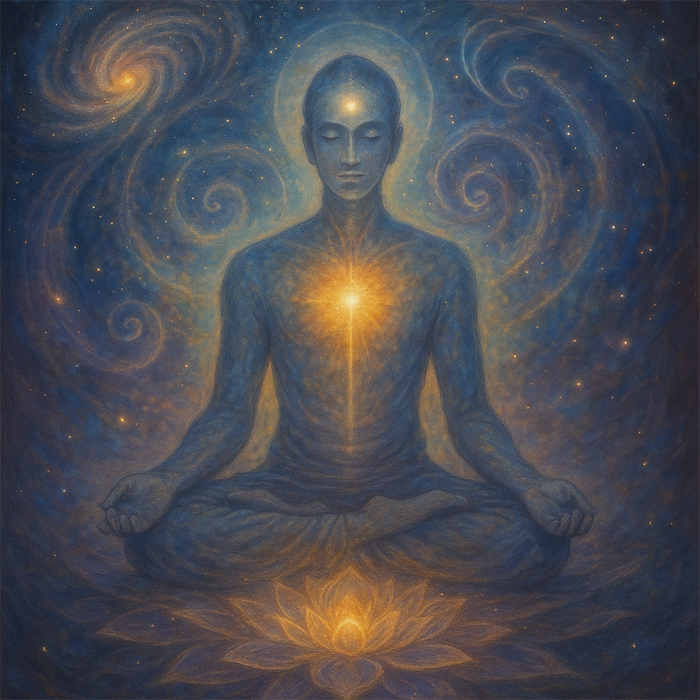
In Hinduism, the soul (Atman) is regarded as the divine spark within each being, identical in essence to Brahman — the universal cosmic consciousness. To discover the Atman is to realize that the separation between the “self” and the world is an illusion, and that, at the core, all is One.
Soul Nebula – IC 1848
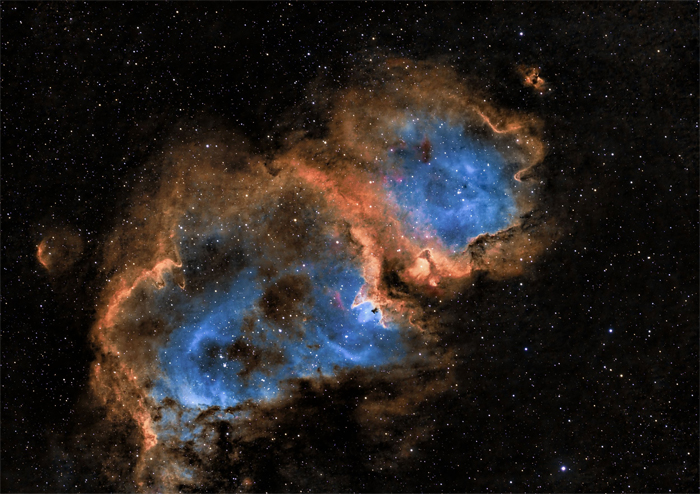
Known as IC 1848 or the “Soul Nebula,” this nebula in the constellation Cassiopeia is a vast cloud of gas and dust located about 6,500 light-years from Earth. Its popular name — the Soul Nebula — arises both from its symbolic shape and from the fascination it evokes for resembling a cosmic representation of the invisible. Beyond its beauty, it serves as a powerful metaphor: like the soul, it is invisible to the naked eye, yet its existence can be detected by more sensitive instruments. Its silent presence in the universe invites us to contemplate the mystery of consciousness and the possibility that what we call the “soul” is as immense, subtle, and enduring as the very structures of the cosmos.
Enjoyed this? Keep reading the other articles. The topics are related, but they do not follow a specific order.
Share this article:

Enjoyed this? Keep reading the other articles. The topics are related, but they do not follow a specific order.
Share this article: