
This time I will ask you not only to think, but also to feel. Close your eyes for a moment and remember a time in your life when you felt shame. Or guilt. Perhaps humiliation or fear. Something striking, like regretting words spoken in haste, a mistake carried in silence, or a fear that paralyzed you. Recall not only the situation but also how your body reacted: your shoulders perhaps tightened, your breath grew shallow, and your mind repeated thoughts that seemed to trap you in a cycle with no escape. Everything felt heavier, slower, more contracted. It was as if life itself had turned down its volume.
Now, change the memory. Recall a moment when you felt deep gratitude. Or true love. Spontaneous joy. Inner peace. Maybe it was when you looked into someone’s eyes and felt love and connection without needing words, or when you contemplated something simple and beautiful, or when you felt in harmony with what you were living and grateful simply for being alive. Again, notice the body: perhaps your breath opened, your chest expanded, time seemed to slow, or simply flow. The mind felt clearer, thoughts more spacious, the heart more present. Everything seemed lighter, brighter. As if you were in tune with something greater than yourself.
This difference between emotional states is not merely poetic nor restricted to spiritualist contexts; it is scientifically measurable. Different emotions generate distinct physiological states, which can be observed in patterns of heart rate, brain activity, breathing rhythm, and skin conductivity. Recent research shows that emotions can indeed be associated with vibrational frequencies, often measured in hertz. Emotions such as shame and guilt vibrate at very low frequencies, around 20 to 30 Hz. States like love, gratitude, and peace are expressed in higher ranges, sometimes exceeding 500 Hz, depending on the methodology used.
Each emotional state corresponds to a measurable frequency that affects the body’s biochemistry, the quality of thoughts, and even the kind of reality we attract or construct around us. Higher emotions generate more coherent electromagnetic fields, strengthen the immune system, foster empathy, and expand our perception of time and possibilities. Denser emotions, on the other hand, tend to produce rigidity, reactivity, repetition.
Our emotions are not something we can control at will. It is no use to decide that from this moment on you will have the inner peace of a Buddhist monk and go around “vibrating” at 500 Hz. It will not last long. You might be working on something important and your computer stops working, a reckless driver may honk at you impatiently, or even a well-aimed pigeon may soil your brand-new clothes. Your inner peace vanishes.
We must be conscious that our emotional frequency varies greatly, depending on the context we are in, and tends toward a certain balance shaped by our overall emotional and vibrational state. If you are calm, optimistic, and cultivate gratitude, your “needle” will naturally gravitate toward a higher frequency. If you are pessimistic, irritable, and easily angered, your baseline will tend to a lower one. No matter how sad or distressed we may feel, those emotions will not last forever, just as even the greatest joy is not eternal.
Although emotion is a fundamental part of human experience, it is not the only tool we have. We can also use reason and consciousness to work alongside emotions.
Try this experiment: when you find yourself at an emotional peak, whether positive or negative, step aside imaginatively and observe yourself as if you were another person, like watching a movie. Analyze the situation as a whole using reason. I know it is very difficult to master the emotion of the moment and do this, but little by little, as you learn to manage emotions instead of being dominated by them, you begin to stay conscious even while feeling, no longer a hostage to automatic reactivity.
Over time, this practice transforms what once seemed uncontrollable into something understandable, modifiable, human. You do not stop feeling; on the contrary, you feel with more depth. You recognize that emotion is a wave, and you are not the wave; you are the ocean. The more you learn to surf this dynamic of feeling, observing, and thinking, the more you refine your emotional intelligence: the kind that welcomes, understands, and chooses rather than merely reacts, giving an upgrade to your overall emotional state.
Emotion, therefore, is more than an inner state: it is a living frequency that flows through the body, the mind, and consciousness. Learning to perceive these frequencies is like learning a new form of listening, subtler, more sensitive, more honest. Not to deny or avoid heavy emotions, but to understand them as transitional states, as steps on an inner ladder that are necessary for our growth and evolution.
We often label certain emotions as negative, as if they were flaws to be corrected. But there is nothing wrong with feeling fear, sadness, or anger. These emotions serve a purpose. Fear can protect us from real danger, sadness can guide us toward the necessary retreat for inner healing, and anger can awaken a dormant strength in the face of injustice. The problem is not in feeling these emotions, but in being dominated by them, in failing to understand what we feel and to learn from it.
The word “emotion” comes from the Latin emovere, meaning “to set in motion.” And perhaps this is one of the best definitions we can have: emotions are forces that move us. They push us to act, to stop, to seek meaning, to protect what we love, to transform what hurts. We do not need to eliminate sadness, suppress anger, or fake a joy that is not real. We need to recognize that every emotion is valid, but not every emotion needs to be obeyed. We must welcome what we feel, understand where it comes from, what it wants to tell us, and what we can learn from it.
Heavy emotions can become gateways to profound lessons that turn into wisdom. Elevated emotions, when genuine, must be acknowledged, understood, and cultivated to help us reach a higher emotional baseline.
True emotional evolution is facing difficult moments with lucidity and living joyful moments with humility.
Danger alert! All hands on deck!
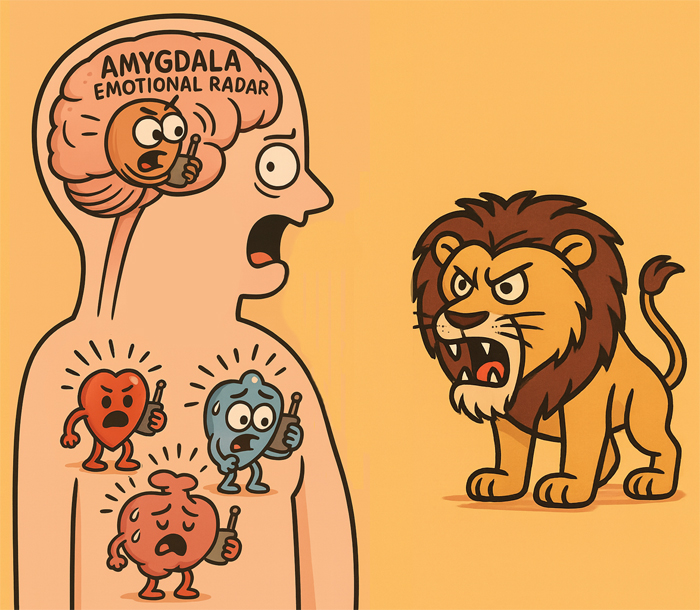
One of the main emotional centers of the brain is the amygdala, a small almond-shaped structure located in the limbic system, which works like a primitive emotional radar. It quickly evaluates environmental stimuli in search of signs of threat or reward, triggering reactions of fear, alertness, or pleasure—often before we are even aware of what is happening. When the amygdala detects a possible threat, it triggers a cascade of automatic physiological reactions: the heart races, the muscles contract, breathing intensifies, preparing the body for the famous “fight or flight” mode. It is an ancestral reaction, inherited from our ancestors, which ensured the survival of the species in the face of predators and real dangers. The problem is that, in the modern world, the “threat” can be an aggressive email, an argument in traffic, or an inner self-criticism—but the body reacts as if it were facing a lion.
The power of love

Love is among the highest of human emotions. Not the idealized love of romance or eternal promises, but love as a state of presence, care, and genuine connection with others and with oneself. Neurobiologically, love activates the brain’s reward systems, releasing oxytocin, serotonin, and dopamine, promoting well-being, trust, and social cohesion. Vibrationally, it raises our inner frequency, expanding perception and harmonizing body and mind. When consciously felt, love acts as a natural antidote to fear, anger, and anxiety. It reorganizes our chemistry, calms the overactive amygdala, and strengthens the noblest parts of our brain — such as the prefrontal cortex, where empathy, ethics, and reflection reside. To love is, therefore, more than a feeling: it is a state of consciousness that reshapes the world from the inside out.
Frequency of Emotions Scale
| Main Emotion | Freq. (Hz) | Inner State |
|---|---|---|
| Enlightenment | >700 | Union with the Whole, transcendence |
| Peace | ~600 | Inner silence, completeness |
| Joy | ~540 | Unconditional love, gratitude |
| Love | ~500 | Compassion, deep connection |
| Reason | ~400 | Mental clarity, understanding |
| Acceptance | ~350 | Flexibility, openness |
| Willingness | ~310 | Confidence, readiness |
| Courage | ~250 | Conscious action, overcoming |
| Neutrality | ~200 | Balance, non-reactivity |
| Pride | ~175 | Defensiveness, vanity |
| Anger | ~150 | Frustration, drive for change |
| Desire | ~125 | Attachment, neediness, ambition |
| Fear | ~100 | Worry, withdrawal |
| Grief | ~75 | Mourning, melancholy, giving up |
| Apathy | ~50 | Indifference, resignation |
| Guilt | ~30 | Self-punishment, unworthiness |
| Shame | ~20 | Humiliation, annihilation |
The Scale of Emotional Frequencies was created by David R. Hawkins, a psychiatrist, philosopher, and researcher of consciousness, widely recognized for integrating science, spirituality, and psychology in his studies. Hawkins proposes that each human emotion emits a measurable vibrational frequency, directly related to a certain level of consciousness and to the impact it has on our lives. Using a methodology based on kinesiology tests — which evaluate muscular responses to the energetic stimulus of ideas or emotions — he organized these emotions into a gradual scale, ranging from the densest and most limiting to the highest and most expansive.

Enjoyed this? Keep reading the other articles. The topics are related, but they do not follow a specific order.
Share this article:
Enjoyed this? Keep reading the other articles. The topics are related, but they do not follow a specific order.
Share this article: