
What is real to you? Is it what you see, think, or feel? Can we truly define what is real or not based only on our own reality—that is, the way we see, perceive, and understand the world? What feels real to you, would it also be real for someone else? Reality is not something fixed, absolute, or identical for everyone. It depends greatly on our perceptions, experiences, and the context in which we are immersed.
Reality can also be simple and objective, as in the famous phrase by Descartes: “I think, therefore I am.” How could one doubt that? If you did not exist, you would not be thinking, right?
Reality also varies in levels of certainty. Some things you know are real because you can simply observe them: you need to breathe to survive, you feel a heart beating in your chest, water boils at 100ºC, and there are stars in the sky.
Beyond observation, there are things you can deduce and prove—for instance, that the sun will rise every morning, or that if you throw something upward it will fall back down due to gravity. For science, reality is something observable and replicable under experimental conditions. Newton saw an apple fall from a tree and, reflecting on it, began developing his ideas about universal gravitation, which led him to formulate the principles of classical physics.
There are also many things we believe to be real because they are common sense, part of the “shared reality” that emerges through social consensus, culture, education, and the history we are told. Much of what we take as objective truth is, in fact, a social construction—something “real” because we collectively agree to believe in it. Let’s look at a few examples:
“The Earth is round.”
Today, this is considered a scientific fact, but it was not always so. In the past, it was believed that the Earth was flat, and that was the “reality” of the time. What changes is the knowledge available and accepted by a society.
“A hundred-dollar bill is worth one hundred dollars.”
This is a classic example of symbolic reality. The paper itself has little intrinsic value. Its worth comes from collective agreement and trust in the economy that supports it.
“Columbus discovered America.”
In truth, this is a European historical narrative. Indigenous peoples had inhabited the Americas long before Columbus. Yet for centuries, this narrative was taken as “real” because it was taught and reproduced as official truth.
“Dinosaurs once existed.”
This belief is based on scientific evidence, such as fossils. Still, the way dinosaurs are depicted in movies, books, and museums is also a cultural interpretation based on scientific hypotheses—and those hypotheses change over time.
These examples show how reality can be a blend of facts, interpretations, and social constructions. Some of these ideas are supported by science, others by culture, others by tradition. But all share in common the fact that they are accepted as real by a collective.
There is also a perspective that is only our own, which only we ourselves can know to be real—our thoughts, feelings, personal tastes, and experiences. You may like mint ice cream, while someone else may not. For you, this flavor is delicious; for the other person, it is unpleasant. On a day when you feel unwell or burdened, life may seem hard to bear; on a day when you feel joyful, everything feels lighter. These variations from person to person are practically infinite.
And what about your wildest dreams, the strong pull of intuition, or the love for someone dear? Each person has their own reality, a mixture of multiple layers and perceptions, passing through many filters before reaching and shaping their own “I think, therefore I am”.
Beyond that certainty, it is hard to be sure of anything else. What truly guarantees that the world is as you perceive it? Is the Earth really round? Have you ever boarded a rocket and seen it with your own eyes? Those who have say the experience is so striking that it paralyzes them, changing their lives forever.
What guarantees that you are not living inside a simulation, within a holographic world? Our perception of reality is filtered through our senses, which can be deceived (optical illusions, dreams, hallucinations). Even our memories are fallible. Perhaps you are nothing more than a line of code in an immense, unimaginably advanced program created by a superior intelligence.
But there is no need to panic, rushing off in search of a “red pill” like Neo in The Matrix to awaken. You do not need to see everything with your own eyes in order to accept something as real. Pay attention to your intuition, your feelings, and your logic. Think infinity, seek knowledge, and filter what is useful to you. It is healthy to doubt, to question, and to seek to understand why you believe what you believe. This tension between doubt and trust is precisely what fuels human knowledge.
Accept that your ‘reality’ is not all of reality, and that it may be far more complex, mysterious, and surprising than it seems.

“I think, therefore I am”
René Descartes
This sentence is one of the most impactful and influential in human history. It represents a radical turning point in the way we conceive reality. With just three words, masterfully combined, he found a firm, undeniable ground: he realized that he could doubt everything, but he could not doubt that he was doubting—and therefore thinking, and thus existing.
The Truman Show

In this film, starring Jim Carrey, a man discovers that his entire life has been manipulated as part of a reality show broadcast live. Upon realizing the deception, he confronts his fears and chooses to seek truth and freedom outside the artificial world created for him. The revelation of this false reality not only changes Truman’s life, but also leads the audience to reflect on the nature of reality, the manipulation of the media, and the limits of individual freedom.
Would you take the red pill?
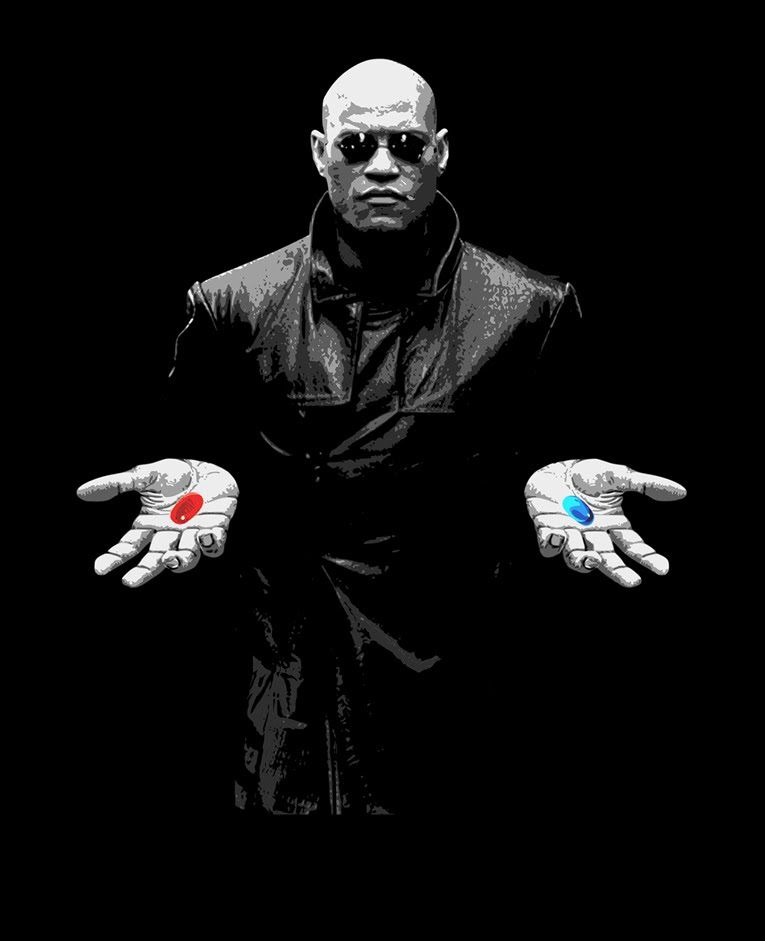
In the movie The Matrix, Morpheus offers Neo the chance to discover his true reality. Neo must choose between truth and continuing his life as it was. If a Morpheus appeared in your own life, as he did for Neo in The Matrix… would you prefer to uncover the true reality and face radical changes, or live comfortably deceived?
Overview Effect
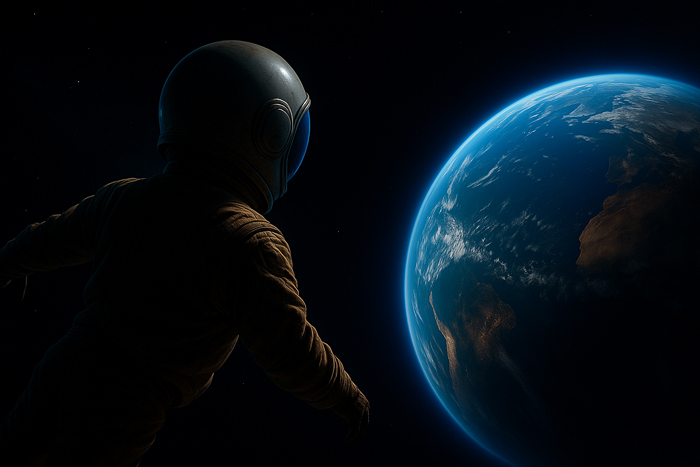
Those who see Earth from space often report experiencing what is known as the Overview Effect—a profound shift in the perception of reality, humanity, and the planet itself. To see Earth as a fragile blue dot, suspended in the void with no visible borders, sparks an existential re-evaluation. Many astronauts describe this experience as transformative, leaving a lasting psychological impact.
And what if you were just an NPC?
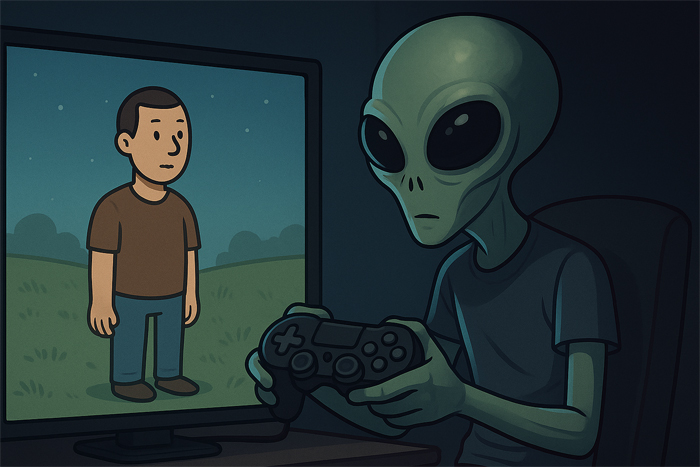
NPC stands for Non-Playable Character. In games, it refers to a character controlled by the system rather than the player. There is no way to prove with absolute certainty that the world is “real” and not a simulation. If technological civilizations advance far enough, they could create simulated realities inhabited by conscious beings. And if that is possible, then statistically it is likely that we are living in one of these simulations. You might be an NPC… but the very fact that you can consider this possibility already shows that there is consciousness. The world may be a hologram, but even so, the experience is real for the one who lives it.

Enjoyed this? Keep reading the other articles. The topics are related, but they do not follow a specific order.
Share this article:

Enjoyed this? Keep reading the other articles. The topics are related, but they do not follow a specific order.
Share this article: