
The concept of evolution, in general, means change or gradual development over time. This idea can be applied to many contexts—biological, cultural, technological, social, and others. It is a continuous process of progressive transformation from something simpler, rudimentary, or initial into something more complex, adapted, or efficient.
Evolution, with its tendency toward diversity and complexity, is a fundamental property observed throughout the universe, from atoms to galaxies. Shortly after the Big Bang, almost 100% of matter was made up of hydrogen, the simplest atom (formed by just one proton and one electron), along with a small portion of helium, the simplest atom after hydrogen. These two primary elements gave rise to the first stars. From them, about 20 heavier chemical elements were produced.
The next generation of stars relied on this diversity to create nearly 100 elements, in a continuous process of transformation where the interior of the stars acted like a true “factory” of elements. Under conditions of extreme pressure and temperature, elements fused into heavier ones such as iron, oxygen, and carbon. When the nuclear fuel of these stars ran out, they exploded, scattering these heavier elements throughout the universe. Gravity then gathered this cosmic dust again, forming galaxies, new stars, and planets.
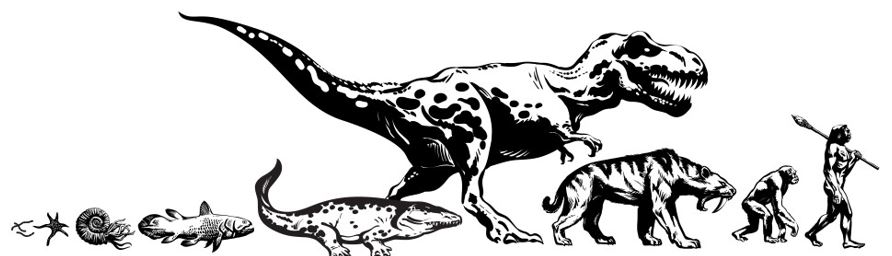
When we think of evolution, the first thing that usually comes to mind is biological change—the evolution of life on Earth. Just as impressive as life’s evolution, however, are the conditions that made its emergence possible.
Stellar dust containing more complex elements clumped together under the force of gravity, forming a sphere of incandescent material that gradually cooled. This allowed heavier elements to sink to the center while lighter elements remained on the surface. As the planet’s temperature changed, huge amounts of gases and water vapor were expelled from Earth’s interior. These gases created the atmosphere, which played crucial roles in the emergence and maintenance of life on Earth—regulating temperature, providing essential gases for respiration and photosynthesis, and enabling water distribution through hydrological cycles. The movement of Earth’s iron core, in turn, generated a magnetic field that protected the atmosphere, and later, life itself, from harmful solar radiation.
The water vapor in the atmosphere led to the first rainfalls, and over long cycles of precipitation, the primitive oceans were formed, about 20 centimeters deep. These early oceans were a broth of diverse elements exposed to energy sources such as lightning and ultraviolet radiation. These elements combined into increasingly complex molecules until they organized into systems capable of self-replication—that is, producing copies of themselves. Once self-replicating systems appeared, natural selection began to act, favoring those more efficient at replicating and surviving, eventually leading to the complex life we see today.
We can also point to other examples of evolution, such as technology. Children of the 1980s belong to the generation that has most intensely experienced the technological transformations of our world. They grew up in an analog reality, witnessed the rise of the internet and cell phones, and the transition of media into digital formats. Today, they are living through the impact of artificial intelligence across many fields of human activity, and will certainly witness other rapid and radical changes, since technology continues to advance at an exponential pace.
The word “evolution” depends greatly on context. Evolution is not always a synonym for progress or improvement. A disease, for example, may evolve toward someone’s recovery—or their death. Biological evolution may give rise to eyes in a living being, but it can also eliminate them, as in the case of animals that live in dark caves or at the bottom of the ocean. Another example can be found in the many human civilizations that, throughout history, evolved to a certain peak, only to later decline or even vanish.
Although evolution, on a universal scale, tends toward complexity and diversity, it can also follow different paths. In some situations, it abandons complexity in favor of simplicity, seeking efficiency; in others, it sets aside diversity to privilege what best adapts to a particular context.
Evolution is not linear, nor does it follow fixed rules. It is shaped by time, guided by trial and error, exploring all possibilities within the reality in which it manifests.
Stellar Evolution
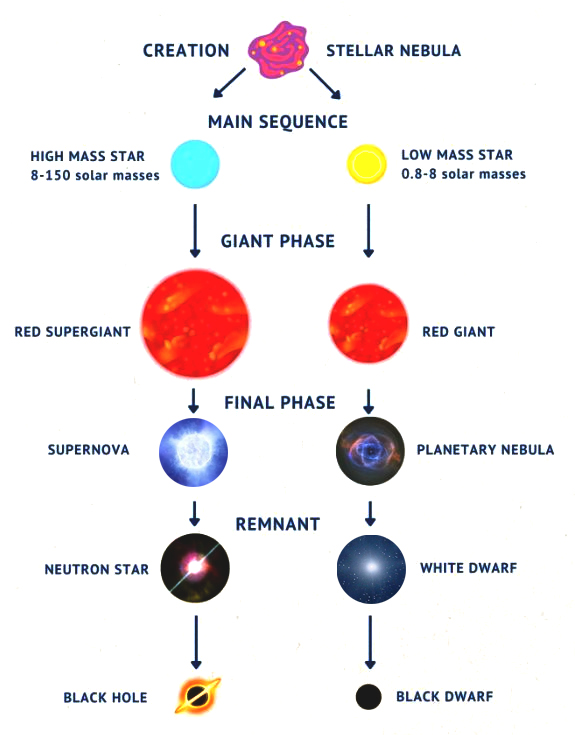
Stars go through changes throughout their existence, much like the stages in the life of a living organism. These changes are driven by nuclear reactions at the core of the star, and its mass determines both its lifespan and its ultimate fate.
Gadgets from the 80s

The migration from physical media to the “cloud” was a profound transformation—both technological and cultural. This shift marks a change in how we relate to content: we are no longer owners of the files, but temporary users of services that store everything on distant servers. This irreversible change has brought immense convenience and accessibility. Yet, it also raises important questions about ownership, security, and the preservation of our digital legacy. And it stirs a sense of nostalgia in those who lived through that era. For many, the value of physical media also lies in its tangibility, in the cover art, the booklets, and the joy of collecting. The cloud does not offer that kind of experience.
Human-driven evolution

Over thousands of years, humans domesticated the wild wolf, shaping not only its behavior but also its physical traits and temperament. What was once a feared forest predator—an agile and independent hunter—gradually transformed into our loyal companion, a universal symbol of friendship, loyalty, and harmonious coexistence. This profound change was not a natural or spontaneous process, but the result of a long and complex history of interaction, mutual adaptation, and careful artificial selection, through which humans influenced each generation, bringing the animal ever closer to everyday life.

Enjoyed this? Keep reading the other articles. The topics are related, but they do not follow a specific order.
Share this article:

Enjoyed this? Keep reading the other articles. The topics are related, but they do not follow a specific order.
Share this article: